
Online Gambling Industry Guide
Online Gambling Industry Guide: How the iGaming Sector Works
We are now expanding into B2C, publishing player-facing casino reviews and category pages for players across international markets.
The two sides feed each other. We know exactly how these bonus terms are drafted before they are published on the bonus page. We know why a withdrawal request which should take ‘1–3 days’ to process can remain in the ‘manual review’ stage for a whole week. We are aware of what goes on behind the scenes when you receive a KYC alert.
That is why, when we review a casino, we don’t just look at its homepage. We also scrutinise the small print. We read through the entire terms and conditions and the cashier section, as we know the summary rarely tells the whole story.
On every page, you will notice we hold ourselves to the same standard. We answer your questions directly. We state findings, not opinions. And we don’t sugarcoat anything just to make a casino look good. We call out limitations that could catch you off guard.
Whichever side of the industry you are on, we hold every page to the same standard and we don't sugarcoat anything to make a casino or a programme look better than it is.
The online gambling industry consists of casino games, sports betting, poker, lottery products and other forms of online wagering services that are available to consumers worldwide. Our Online Gambling Industry Guide breaks down how the industry operates, what its main products are, common business models, technology providers, licensing and player protection standards. We'll also highlight current market trends, marketing channels, career options and the top trade publications, forums and iGaming events to keep up with in 2026.

What Is the Online Gambling Industry?
The online gambling industry is made up of websites and apps that offer games and real money wagering. Common products in the industry are online casino games, sports betting, poker sites, bingo halls, lotteries, live dealer games, crash games and esports betting. Games are powered by software providers. There are also many ancillary industries which provide the technology, payment processing, compliance, and marketing services. The entire industry also contains the customer-facing brands, companies that power their software, companies that process their transactions and verify players, and companies that license suppliers to online casinos. When we refer to iGaming, we look beyond individual sites to the entire commercial ecosystem that surrounds them.
Essential iGaming Terms for Newcomers
These terms appear throughout the online gambling industry:
| Term | Meaning |
|---|---|
| Operator | A licensed business that offers gambling products directly to players and is responsible for regulatory compliance. |
| Supplier | A company that provides games, platforms, odds feeds, payment technology or compliance tools. |
| Affiliate | A publisher or marketer that refers players to operators in return for commission. |
| Aggregator | A supplier that combines games from multiple studios into one integration for operators. |
| White label | A service that allows a company to operate a branded gambling site using infrastructure supplied by another business. |
| GGR | Gross Gaming Revenue: total player stakes minus winnings paid out, before operating costs. |
| NGR | Net Gaming Revenue: GGR after agreed deductions, such as bonuses, payment fees and certain taxes. |
| KYC | Know Your Customer: the process used to verify a player’s identity. |
| AML | Anti-Money Laundering: controls used to identify, monitor and report suspicious financial activity. |
How the Online Gambling Industry Works
The online gambling industry functions via an interlinking network of companies, tech vendors, marketing organisations, and regulatory bodies. The operators deliver the client service directly, while platforms, game developers, sports content providers, payment solutions and affiliates help to deliver various steps of the gaming process.
Every company plays its own commercial part in that process; however, the operator who is usually licensed stays responsible for the delivery of the service. For that reason, every supplier has to satisfy all technological and regulatory requirements in the respective markets.
Operators and B2C Gambling Brands
Licensed operators form the epicentre of the B2C market. Revenue for the casino is driven by the house edge, whereas for the sportsbook, a margin is included within the odds. Then, GGR gets converted to NGR by deducting costs such as bonuses and fees. Operators segment players according to markets, currencies, devices and value and can either manage all their technological operations, payments and customer service internally or through third parties. The key balance is always between control and speed.
Software Suppliers, Game Providers and Technology Partners
Game software suppliers sell you the technology systems you don't have time to develop yourself. Some suppliers specialise in player accounts, wallets, cashier systems, game aggregators, live dealer studios, odds feeds, CRM applications, bonus engines and compliance technology. Gaining market entry to regulated territories is heavily reliant on certification. Software and games may require certification for each separate jurisdiction, with RTP, security and technical standards examined prior to launch. Vendors with established history have had products tested and approved in multiple markets.
Affiliates, Publishers and Marketing Partners
Affiliates and publishers typically drive traffic to operators through comparison pages, reviews, news articles, guides or paid advertising campaigns. Some begin by starting a website without a large upfront budget and gradually building an audience around a particular market or topic. Publishers are typically paid on a CPA, revenue share or hybrid commission structure. Attribution windows determine which affiliate is credited for a registration. There are several affiliate compliance factors to consider when onboarding publishers. Affiliates should follow responsible local advertising requirements, provide commercial link disclosure where necessary and prominently display responsible gambling messages. Publishers who send non-compliant traffic, or traffic that will not play responsibly once registered, can subject the publisher and operator to unwanted regulatory scrutiny.
Regulators and Independent Testing Organisations
Game regulators grant licenses to operators, set standards, may collect tax and enforce their regulations. Gambling commission registers allow players to verify that a company holds a valid license. Gambling testing labs ensure games are fair, RNG’s are compliant, websites are secure and operators meet technical standards. Regulators define what needs to be proven, while the laboratories certify the software performs those functions correctly.
The Main Gambling Verticals and How They Differ
Five verticals account for most of the online gambling market. Each has a different product format, revenue model, level of operational complexity and approach to player retention.
| Vertical | Core product format | Revenue model | Operational complexity | Retention profile |
|---|---|---|---|---|
| Online casino | RNG slots and table games | House edge across betting volume | Moderate | High and session-driven |
| Sports betting | Pre-match and live-event odds | Margin built into the odds | High and event-dependent | Strong during major seasons |
| Poker | Player-versus-player games | Rake and tournament fees | High and liquidity-dependent | Very high and community-driven |
| Bingo | Community-based draw games | Card sales and game fees | Moderate | Strong social loyalty |
| Lottery | Draw tickets and instant-win games | Fixed allocation of ticket sales | Low to moderate | Habitual but less frequent |
Casino margins are fairly predictable as every game has a mathematical bias, while sportsbook profits are more seasonal and dependent on outcomes and big events. Poker and Bingo are both heavily reliant on community engagement, whereas the lottery usually has a smaller but more occasional audience.
Online Casino and Live Casino
Online casino games generally fall into two categories: RNG-based games and live dealer games. RNG games include slots and digital table games such as blackjack, roulette and baccarat. Many slots have a theoretical Return to Player of 94% to 97%, although this varies by game, configuration and market and does not guarantee individual results.
Live casino games use real dealers and physical equipment, including cards and roulette wheels, with play streamed online. Developers create the software, rules and mathematical models, while regulated markets usually require independent testing or certification. However, exact requirements can differ between jurisdictions.
Sports Betting
Sportsbooks take odds for sporting events using betting teams, automated risk engines and live feeds. Operators apply an overround, ensuring there is a price margin in the odds. Liability management tools may be used to limit exposure to certain outcomes. When offering in-play betting, the technical element adds a requirement to move odds as action occurs.
Regulatory requirements vary by jurisdiction. This can include allowing limits on certain types of bets, advertising standards or in-play wagers. Other rules may include mandating sharing of game integrity data with sporting organisations.
Poker, Bingo, Lottery and Other Verticals
Poker is different from a casino in that players are playing against each other rather than the house. The operator makes money by charging rake on cash games and entry fees for tournaments. The key to poker’s success is ensuring there are enough players online at all times to populate tables.
Bingo is another game that revolves heavily around a sense of community. Operators merge low-stakes draw games with chat and socialising features. Lottery products are frequently state-run, state-licensed or both. A percentage of ticket sales are typically ring-fenced for prizes, and in some jurisdictions, public programmes.
How Large Is the Online Gambling Industry?
Market estimates can differ significantly due to different research methodologies and definitions. With that in mind, it is essential to remember the source of the data, the year of publication, and specific measurements when comparing the figures. According to the reports published by H2 Gambling Capital and Statista in 2024 and 2025, the global online gambling market ranged between $90 billion and $100 billion in gross gaming revenue (GGR) on an annual basis and is projected to grow by approximately 9–11% CAGR through the end of the decade.
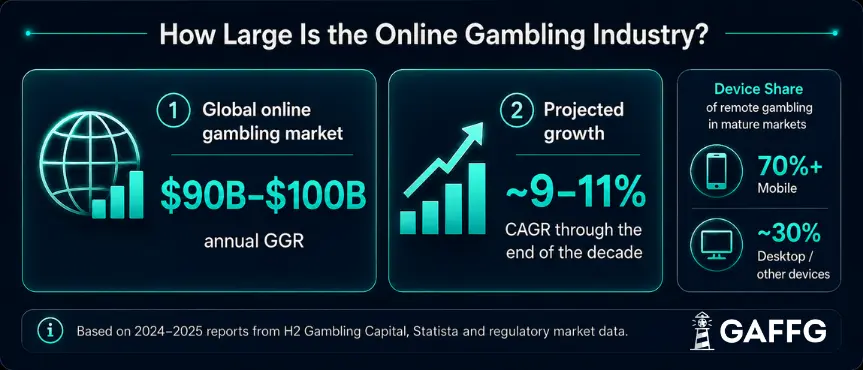
The online gambling market is heavily dominated by mobile devices in most of the mature markets. Several studies conducted by regulatory authorities released in 2024 indicated that over 70% of remote gambling proceeds in the UK, Europe, and North America originate from mobile devices. Additionally, it is vital to note that regulator reports typically offer the most reliable insights into the precise regional level of the online gambling market. For example, the UK Gambling Commission regularly releases remote gross gambling yield data on an annual basis, while most European and American regulators follow suit by publishing similar findings. It is important to double-check the dates of reports and ensure that the figures represent the volume of money wagered, gross gambling revenues, or net revenues, as these metrics are often used interchangeably.
How Regulation Shapes Growth Across Different iGaming Markets
Consumer demand is one factor that can affect market growth. Licensing requirements, tax rates, access to payment methods and advertising limits also impact which products can operate, as well as how competitive regulated businesses can be.
- Europe: One of the most mature regions, although rules differ considerably between countries. Online gambling generated an estimated €47.9 billion in GGR in 2024, accounting for 39% of Europe’s online casino market. Advertising, affordability and player-protection requirements are becoming stricter in several jurisdictions.
- North America: Industry expansion has been driven primarily by US states’ decision to legalise their markets, following a much longer history of gambling and iGaming in the US. As of July 2026, sports betting is live and legal in 39 states and Washington, DC, while full online casino gaming operates in far fewer states. Online casinos licensed in each jurisdiction can only offer services to consumers within that territory. Each country sets its own licensing conditions, tax rates and which products can be offered to consumers.
- Latin America: A handful of countries have established or revamped their local licensing regulations. Brazil established its regulated fixed-odds sports betting market on 1 January 2025, setting out national licensing rules as well as guidelines around payment processing, advertising and responsible gambling. Elsewhere in the region, regulations vary widely from country to country.
- Asia-Pacific: Regulations vary widely across the region, with regulated markets operating alongside countries that restrict or prohibit certain products. In Australia, the Interactive Gambling Act 2001 prohibits operators from offering online casino games and online in-play sports betting. Licensed wagering operators can offer permitted sports and racing products under state or territory licences.
- Africa: Gambling regulations differ considerably between countries and, in some markets, between regional authorities. South Africa permits online sports and horse-racing betting through bookmakers licensed by provincial gambling authorities. However, interactive casino games remain prohibited under the National Gambling Act 2004, and offshore operators cannot legally offer services to local consumers.
Online Gambling Regulation and Licensing
Online gambling is regulated on a country-by-country basis. A licence issued in one jurisdiction does not necessarily permit operation from that operator in another, and individual countries can impose their own requirements on products offered, advertising, taxation, and overall player protection. As such, operators who do business within multiple regions will need to acquire several licenses.
Some of the most sought-after jurisdictions include:
- Malta Gaming Authority (MGA): A long-established European regulator with a public register for checking licensed operators and suppliers.
- UK Gambling Commission: Regulates gambling activity within Great Britain. Enforces comprehensive rules around player protection, advertising, and money laundering requirements.
- Gibraltar Regulatory Authority: Regulates gambling operators that have been licensed in Gibraltar. Home to several well-known international operators.
- Isle of Man Gambling Supervision Commission: Isle of Man jurisdiction which regulates online gambling operators who are located on the island. Enforces regulations around technical standards as well as money laundering requirements.
- Kahnawake Gaming Commission: An established gambling licensing authority located in the Mohawk Territory of Kahnawake, Canada.
- National gambling authorities: Many countries have begun regulating online casinos, sports betting and lottery products through national or regional channels.
Licensing jurisdictions are not global. A gambling operator may be licensed in one country but blocked from offering services to players in another. As such, players and partners should check the validity of an operator’s licence through the official registry of the regulating jurisdiction.
KYC, AML and Age-Verification Requirements
Licensed operators must verify who their customers are, confirm that they meet the legal gambling age and monitor how money moves through their accounts. KYC rules determine a player’s identity, while AML regulations allow operators to monitor and report suspicious financial transactions. Most countries' standards are based on recommendations from the Financial Action Task Force.
Typical regulations include the following:
- Identity and age verification: Confirmation of a player’s name, date of birth and identity using official documentation. This is usually done during registration or before a customer can engage in certain account activities.
- Source of funds and wealth checks: Documentation that verifies where the funds being wagered or withdrawn came from once they reach a certain threshold.
- Transaction monitoring: Flagging suspicious patterns of deposits, wagering activity or withdrawals.
- PEP and sanctions screening: Checking customers against politically exposed person and official sanctions lists.
- Suspicious activity reporting: Referring potentially suspicious transactions to the relevant financial intelligence authority.
- Record keeping: Retaining customer and transaction records for the period required by local law.
Responsible Gambling and Player Protection
Rules on responsible gambling allow players to manage their own spending and give operators a clear obligation to act when indicators of harm are displayed. These requirements differ from market to market, but licensed operators are typically expected to provide:
- Deposit, loss and time limits: Controls set by the player and enforced through the account.
- Time-outs and self-exclusion: Pause or block gambling through individual venues or national schemes that apply to all licensed operators.
- Affordability and behavioural monitoring: Checks used in some markets to identify spending patterns or behaviour linked to potential harm.
- Safer gambling information: Easy-to-understand messaging, useful tips and links to independent support.
- Staff training: Training for customer-facing teams so they can recognise and respond to signs of risky behaviour.
Problem gambling can lead to serious financial and personal damage, which is why regulation also extends to prevention, treatment and funding of independent research. Regulation is important, but the regulated industry also brings in tax revenue from home and overseas, creates jobs and develops technology which can be used in sectors like payments, streaming services and data security.
Technology Behind Online Gambling
There are many systems involved in running an online gambling operation, and the digital transformation of online gambling continues to introduce new approaches to mobile delivery, automation, security, and player account management. These systems work together behind the scenes every time a gambler registers, deposits cash or stakes a bet. Records are also created which can be used to support players by the CRM, monitor risky behaviour or prove compliance.
| Technology component | Role in the platform |
|---|---|
| Front end | The website or app used by the player. |
| Player account management (PAM) | Stores identity details, balances and transaction history. |
| Wallet and cashier | Manages deposits, withdrawals, stakes, winnings and bonuses. |
| Game and sportsbook integrations | Connect the operator to games, odds and results data. |
| Game aggregation | Provides access to multiple game studios through one technical connection. |
| CRM and back office | Supports promotions, customer service and account management. |
| Analytics and fraud tools | Monitor behaviour, identify risks and maintain compliance records. |
| Cloud infrastructure | Provides hosting, capacity and system resilience. |
As each bet is placed, multiple systems react within seconds. The player’s account is checked along with their available balance, the wager is recorded in the wallet system before the game or sportsbook feeds transmit the outcome. Any winnings are credited as needed, and the complete transaction is logged. Robust integrations are vital because if a component fails, it could impact gameplay, payments and account balances as well as creating friction for players.
Platforms, Game Aggregation and Testing
Some platforms provide aggregation, which allows operators to access thousands of games from multiple studios via a single technical connection. In reality, the availability of games is still subject to local approvals. Titles may need RNG testing and certification with declared RTP values prior to launch. Software changes to certified games could also require additional review. Some jurisdictions take longer to approve new titles than others.
Payments, Fraud Prevention and Account Security
Operators typically have cards, bank transfers, open banking, e-wallets, prepaid and local payment methods available. Each carries different fees, processing timelines and potential for fraud. Withdrawals can also be delayed due to missing KYC data, mismatched payment method or additional security checks rather than an actual technical issue. Other areas include reconciling transactions across multiple systems, currency conversion and keeping track of chargebacks on card payments. Having a seamless cashier and transparent withdrawal process can help decrease unusable deposits and customer complaints/support tickets.
Mobile Platforms and User Experience
Mobile is often the primary channel through which online gambling customers access their accounts. Registration, payments, KYC verification and account controls should all work easily on mobile devices with smaller screens and touch input. Players might also upload documents or take selfies for ID verification using their phone’s camera. Faster refresh rates are required for betting while watching live events, which also needs stable streaming. Deposit limits, self-exclusion and withdrawals should also be accessible within the mobile experience. Native apps must follow Apple and Google policies, leading some operators to prioritise mobile websites instead.
How Online Gambling Companies Reach and Retain Customers
Operators target new customers primarily through affiliates, search, paid advertising and social media. Affiliates include sites and platforms that present the operator’s brand to potential players. The mix of available channels will depend on advertising restrictions, which vary widely based on local gambling regulations and individual platform policies. Markets with tighter restrictions may rely more on affiliates and organic search.
Key performance indicators used to measure the effectiveness of marketing operations include customer acquisition cost (CAC), player lifetime value (LTV), bonus spend and churn. Churn refers to registered players who stop playing before the operator has recovered its acquisition cost. An operator may receive thousands of registrations from a campaign while losing money if those players churn before spending enough for the operator to break even. Retention ensures existing customers continue playing. Players can be incentivised with emails, push notifications, loyalty programmes, customer service and special offers triggered by past activity.
Affiliates, Organic Search and Paid Marketing
The channels mentioned above vary in cost, benefit and requirements for compliance. Affiliates and organic search both send players to the operator through educational and entertaining content like reviews and comparison websites. Paid channels like search ads and social media often produce faster results, but may come with stricter regulations. Operators must also decide which channel gets credit for a registration or deposit when multiple touchpoints exist. Regulations vary from market to market, as does player behaviour, so most operators have separate strategies for each jurisdiction.
Trends Shaping the Future of Online Gambling
Several product trends are influencing the online gambling industry in 2026:
- Esports betting: Growing alongside competitive gaming audiences and major tournaments.
- Fantasy sports: Often regulated separately because it combines skill-based competition with wagering elements.
- Crash games: Becoming more visible, particularly on crypto-focused gambling platforms.
- Social and interactive features: Adding community functions, skill elements and entertainment layers to established casino and betting products.
Online gambling operators take these factors into account when deciding whether to offer a new format. There’s more to running a book than knowing what’s popular. They also must weigh legal status, margins, liquidity needs, potential for fraud and whether the format is suitable for their current player base.
Online Gambling Industry Resources
Expanding your knowledge base by reading reputable trade publications, joining professional groups and networks, reviewing reports from regulators and attending industry events can help newcomers understand how the industry works. They can be especially useful when learning more about behind-the-scenes processes not generally discussed on websites catering to casino players and bettors.
iGaming News Sites and Trade Magazines
Trade magazines tend to concentrate on the business-to-business (B2B) side of iGaming. This includes everything from regulation and licensing. Sites such as Ace Alliance cover operator and supplier developments, while Affiverse focuses on affiliate marketing and content publishing. Readers can also follow the latest iGaming industry news and analysis on Gaffg. When reading any trade publication, take note of how often they release new articles, whether reporters disclose their sources and how sponsored content is labelled. Business partnerships don’t inherently mean coverage will be biased, but readers should always be made aware.
B2B Forums and Professional Communities
Professional forums and communities allow industry insiders like operators, suppliers, affiliates and service providers to connect, find job opportunities and discuss current events. Users can offer insight into the daily tasks, tools they use and processes they follow. Keep in mind that users are often anonymous, can be biased due to personal experiences or may be posting out of self-interest. View information shared on these platforms as a lead instead of confirmation and fact-check any noteworthy statistics, legal claims or product recommendations using official regulators, company statements or other primary sources.
Market Research and Regulatory Reports
Depending on the figures you’re interested in, data from regulators, audited annual financial reports and companies’ investor relations documents will usually be the most reliable resource. Market research groups like H2 Gambling Capital and Statista can also be helpful, especially if they disclose how they estimate their data. Always check the date an article was published, when the data was reported and what exactly is being measured. The global gambling market size is typically measured in stakes, GGR or NGR, which each define different aspects of the market.
Conferences, Trade Shows and Networking Events
Conferences convene operators, suppliers, affiliates, regulators and technology companies with exhibition halls, panel discussions and scheduled meetings. Events range from those serving the entire industry to ones focused on a specific region, product or business vertical. New professionals should evaluate the agenda, attendees, location and networking opportunities of each event before investing their time and budget. The Gaffg iGaming conferences page provides an overview of upcoming events and the audiences they are designed for.
Career Paths Across the Online Gambling Sector
Online gambling companies hire professionals with specialization in regulation, technology, payments, marketing and customer operations. While many of these positions require iGaming knowledge, there are opportunities for crossover from fintech, adtech, cyber security, streaming and other technology sectors that are heavily regulated.
| Career area | Typical roles and responsibilities |
|---|---|
| Compliance, AML and safer gambling | Regulatory reporting, transaction monitoring, customer checks and player-protection work. |
| Product and trading | Product managers, sportsbook traders and specialists responsible for odds, risk and product development. |
| CRM and data analysis | Retention, customer segmentation, campaign management and performance analysis. |
| Payments and fraud | Payment processing, reconciliation, chargeback management and fraud detection. |
| Customer operations and live casino | Customer support, account management and live dealer studio production. |
| Game mathematics and engineering | Designing game models, developing platforms and building technical integrations. |
| Legal and affiliate management | Licensing, commercial contracts, compliance reviews and partner relationships. |
If you have experience in payments, financial compliance, digital marketing attribution, customer data platforms or live streaming, these are all useful in online gambling. You’ll still need to learn how licensing, technical standards and player-protection requirements impact your role.
What to Know Before Starting a Career in iGaming
Along with transferable skills, new professionals should be aware of regulatory issues. Compliance will impact most positions, while player protection is a practical and moral concern. Many employers also appreciate a specialist who can make connections with licensing, payments, technology and marketing requirements. Being an expert in one vertical or niche can become more valuable than having general knowledge of the entire industry.
Pros and Cons of Working in and Following the Sector
Career options are global, there is high demand for specific skills, and you will learn about cutting-edge technology. You’ll also face high-level scrutiny from legislators and the public.
| Benefits | Challenges |
|---|---|
| International career opportunities across multiple markets | Complex licensing rules and frequent regulatory changes |
| Strong focus on data, analytics and performance | Reputational concerns surrounding the industry |
| Valuable experience in regulated markets | Advertising restrictions that limit marketing options |
| Innovation in payments, platforms and digital products | Ongoing compliance, fraud prevention and security demands |
| High demand for multilingual professionals | Continued debate around gambling-related harm |
If you’re an employee within the gambling sector, you can earn a competitive salary, work internationally and gain experience in technology, finance and/or regulation. The caveat is you will be working in an environment that is heavily affected by compliance requirements, public perception and rules that vary drastically from one market to the next. Those looking to enter the iGaming arena should consider these pros and cons.
Understanding the Online Gambling Industry
The online gambling industry becomes easier to understand once its main areas are viewed together. Regulation determines which products operators can offer and where they can operate. Technology bridges player accounts, payments, games and compliance monitoring systems. Responsible gambling and consumer-protection mandates affect how operators communicate with players and provide player support.
If you’re just starting to learn about the industry, your next step should be to read. Websites of regulators and licensing directories are a great resource, as are industry reports and reputable online gambling publications. Professional forums, conferences and networking events are also helpful to gain further understanding on new regulations, technology, business models and job opportunities. Follow these outlets consistently and you’ll begin to see how the industry evolves and how its individual parts interrelate.