What iGaming Conferences Cover Across the Industry
iGaming conferences are usually focused on the industry’s verticals. Online casinos, sports betting, poker, Esports betting, lottery, affiliate, platform, CRM, retention, payments, and responsible gaming are the main topics that attract the most attention from the conference participants. The iGaming regulators and the specifics of legal entities such as MGA, UKGC, Gibraltar, Isle of Man, Curacao, and others are also high on the agenda.
eCOGRA, BMM test labs, GLI, and other testing and certification organisations that ensure the quality of the gambling software and check the legitimacy of random number generators, are also involved in the main discussion topics. Know Your Customer and Anti-Money Laundering compliance, which has taken centre stage due to FATF, EU, and local regulations, is also on the list. KYC/AML is now a cross-department issue and attracts the attention of not only compliance managers but product managers, commercial directors, market expansion managers, and other professionals.
Main Types of iGaming Conferences and Events
Not all iGaming events are focused on the same topic. It could be a large-scale show or a more niche meeting about regional markets or certain aspects of the industry, like affiliate programmes, compliance, AI, or payments. The main point is that it is easier to choose which events to attend and invest in when the team knows what to look for.
Large-Scale Global Expos
The SBC Summit and SiGMA World conferences generate a significant number of exhibitors and visitors from the iGaming industry, which helps meet a diverse audience of operators, affiliates, suppliers, and service providers. However, the main disadvantage of the event is its noise, which makes it hard to reach an adequate number of meetings. Another downside is that exhibition costs are considered expensive, with a standard booth costing about €15,000 and top-class booths costing over €100,000.
Affiliate and Performance Marketing Events
Events like the AffPapa Conference Cancun are dedicated to traffic acquisition, SEO, media buying, influencer marketing, and performance-driven growth. The participants of these conferences are affiliates, affiliate managers, and marketing directors. These kinds of conferences provide the maximum amount of potential partnerships for any company that needs traffic through third parties for its growth. From our experience, we see that the percentage of converting meetings into partnerships at specialised affiliate conferences is much higher than at other types of expos.
Regional Market Conferences
Regional events such as G&M Events Brazil, CGS Recife, G&M Events Argentina, G&M Events Mexico and SiGMA South Asia help teams understand local market conditions. They are useful for learning about regulation, payment habits, local operators, affiliate networks and supplier relationships. For companies entering a new market, these events can be more practical than relying only on global conferences.
Tech, AI, Blockchain, and Payments Events
The tech track of global conferences covers emerging fields of payments, risk, regulation and tech such as personalisation of AI, blockchain settlements, crypto-wallets, fraud detection, bots, device-printing, and payment orchestration. These topics are of particular interest to CTOs, product owners, and compliance managers who evaluate the cost-benefit of new technology developments or technological innovations applicable to their business, in particular where payments, risk, and regulation intersect.
How to Choose the Right iGaming Conference for Your Goal
It is important not to just pick the biggest or most well-known iGaming conferences. You should match up the types of events and specific factors to the iGaming business needs you want to fulfil.
Define Your Business Goal
Identify what your aims are first—are you after acquisition of affiliate partners, regulatory advice, a launch, market entry contacts, investment or recruitment, or something else? You simply can’t have the same meeting with both a slot supplier and an affiliate programme manager.
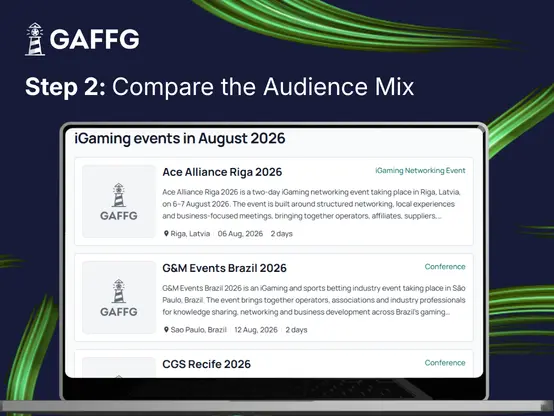
Compare the Audience Mix
The number of attendees is just one parameter. 500 people event with high buyer density might turn out to be better than a 30,000-attendee exhibition where your target audience is not so easily accessible. Prior to making a budget allocation, request detailed information on who is coming.
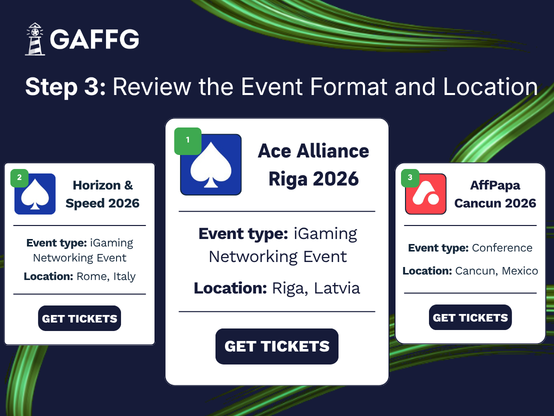
Review the Event Format and Location
Consider practical matters that might affect your turnout. Be sure to check visa regulations, the distance to the hotel, the availability of meeting rooms, the event’s potential for networking, and the presence of any related side events.
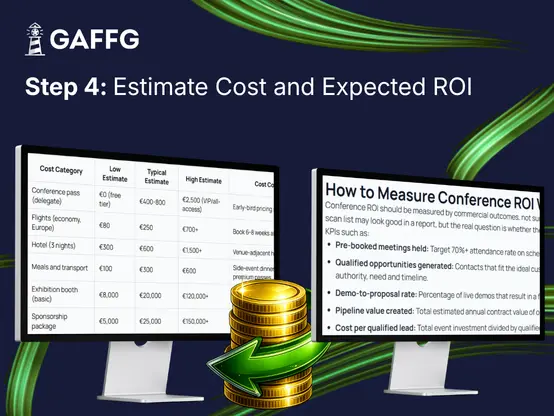
Estimate Cost and Expected ROI
Do not evaluate solely based on ticket price. If your trip costs you €5,000, but generates three qualified leads, each worth €50,000, then the decision is quite simple. But if you spent €80,000 on a booth and got 200 people to scan your badge, but just four qualified leads, then you should rethink.
How Much Does It Cost to Attend an iGaming Conference?
Costs vary a lot depending on the event, location and how you attend. A delegate pass, a two-person business development trip and an exhibition stand all come with very different budgets. The 2026 ranges below give a practical benchmark for European and North American events.
| Cost Category |
Low Estimate |
Typical Estimate |
High Estimate |
Cost Control Note |
| Conference pass (delegate) |
€0 (free tier) |
€400-800 |
€2,500 (VIP/all-access) |
Early-bird pricing saves 20-40% |
| Flights (economy, Europe) |
€80 |
€250 |
€700+ |
Book 6-8 weeks ahead |
| Hotel (3 nights) |
€300 |
€600 |
€1,500+ |
Venue-adjacent hotels sell out fast |
| Meals and transport |
€100 |
€300 |
€600 |
Side-event dinners often included in premium passes |
| Exhibition booth (basic) |
€8,000 |
€20,000 |
€120,000+ |
Includes shell, excludes furniture, power, internet |
| Sponsorship package |
€5,000 |
€25,000 |
€150,000+ |
Compare by cost per qualified meeting, not logo impressions |
The usual expense for a delegate at a European iGaming convention, including travel, hotel, meals, and local transportation, is estimated at €1,200 – €2,500. For a business development team of two, the costs are expected to be in the range of €3,000 – €6,000. The costs for an exhibitor are significantly higher. For example, a medium-sized stand at a large European exhibition may cost anywhere between €40,000 – €80,000 (including the travel and hotel expenses of the delegates, stand furnishings, marketing materials, and client hospitality).
Sponsorship and Exhibition Packages Compared
Sponsorship packages should be measured based on the opportunity for meetings rather than the number of impressions. The most valuable sponsorship packages should deliver speaking opportunities, hosted buyer meetings, branded lounges, app placement and content, and post-event attendee data.
The useful metric is cost per qualified meeting. A €25,000 sponsorship that includes 15 pre-arranged meetings with relevant decision-makers works out at around €1,667 per meeting. A €50,000 package that delivers 5,000 app impressions but only 8 serious conversations comes to €6,250 per meeting. First-time exhibitors should also budget for the extras. Booth furniture can cost €500–3,000, on-site Wi-Fi €200–1,000, electrical hookups €150–500, and lead scanners €300–700 each. These costs add up quickly, especially at larger expos.
How to Measure Conference ROI With Real KPIs
Conference ROI should be measured by commercial outcomes, not surface-level activity. A busy booth or a long badge-scan list may look good in a report, but the real question is whether the event created qualified opportunities. Track KPIs such as:
- Pre-booked meetings held: Target 70%+ attendance rate on scheduled meetings.
- Qualified opportunities generated: Contacts that fit the ideal customer profile and have verified budget, authority, need and timeline.
- Demo-to-proposal rate: Percentage of live demos that result in a formal proposal within 30 days.
- Pipeline value created: Total estimated annual contract value of opportunities attributed to the event.
- Cost per qualified lead: Total event investment divided by qualified opportunities (not total badge scans).
While booth visits, social media mentions, app engagement, and general event engagement will still give you marketing attribution, it’s important to not confuse engagement with revenue. In B2B iGaming, 90-day attribution is standard (and realistic) for most transactions due to the nature of contracts, licensing, and integration.
Lead Quality, Deal Tracking, and Follow-Up
The quantity of contacts is not as important as their quality. If your iGaming conference targeting and appointment setting has been successful, 40-60% of set meetings should result in qualified decision-maker discussions. However, it is crucial to keep track of contacts that have been met.
It is essential to enter all the meeting results into the CRM system within 24 hours. You should also enter the event name, qualification, and next step. It is helpful to write additional information, including market, product interest, budget, and timelines. Although badge scans are a great source of information, they are not always accurate since they include people who have not been contacted yet. Nevertheless, you should follow up with everyone within 5 business days after the event. If you wait too long, the lead will become stale, and you will have less control over the scheduling. In addition, it is more likely for a competitor to contact your prospect if you do not do it in time.
Although event leads are generally qualified, it is crucial to remember that any lead requires nurturing. In particular, the most relevant leads are those who have already met one of your team members. However, even in this case, it is essential to establish a follow-up step. It is optimal to contact a lead within 5 business days after the event while discussions are still hot.
First-Time Attendee Guide for iGaming Conferences
Visitors often underestimate the speed, volume and sheer movement of large-scale iGaming events. The difference between productive visits and costly tourism is preparation.
How to Prepare Before Arriving at an iGaming Conference
- Verify pass type and that it provides entry to the appropriate halls/conference tracks/networking areas, etc.
- Get visa documents well ahead of time; Events in Dubai (UAE), Manila (Philippines) and the United States, in particular, require pre-event applications for many nationalities.
- Book a hotel nearby; places near the event will sell out months in advance.
- Book in advance 8-12 meetings via the event app or direct outreach; hit or miss meetings yield unpredictable outcomes.
- Identify attendee list, speaker list, and exhibitor list; develop 20-30 targeted prospects in priority order.
- Set daily objectives: number of meetings, topics to drill down on, confirming contacts for follow up.
- Prepare CRM fields for lead capture: event name, contact role, company, jurisdiction focus, product interest, and next step.
- Pack chargers, international power adapters, a portable battery, business cards (yes, even in Asia they are still expected), and comfortable professional footwear.
How to Network Effectively During the iGaming Event
A good event schedule should include both planned meetings and room for unexpected conversations. As a simple guide, keep around 60% of your time for pre-booked meetings and leave the remaining 40% for walking the expo floor, attending relevant sessions and joining side events. Spontaneous introductions can be valuable, but relying on chance alone is too risky.
After each meeting, write down the next step straight away. A quick phone note is enough if you are moving between appointments. Once you have had 10 or 15 meetings in a day, it becomes easy to forget who asked for pricing, who needs a proposal, and which market they were focused on.
When qualifying a contact, keep it practical. Note their market, product need, decision-making role and likely timeline. Teams should also be careful with gifts, hospitality and personal data. For European contacts, GDPR rules apply, so only add people to follow-up lists when there is clear consent.
Emerging Conference Tracks Shaping the Sector
iGaming conference agendas in 2026 will veer away from slots and sportsbook topics and delve deeper into compliance, safer gambling, payments, AI, fraud prevention and product infrastructure topics that cut across the online gambling industry.
Responsible Gambling and Compliance Sessions
Responsible Gambling & Compliance sessions have become a big topic at any iGaming conference, and it does not come as a surprise at all. In cases where licensing, payments and advertising clearances will increasingly depend on having certain safer gambling measures in place, this is information that is truly gold to businesses. In 2026, look forward to more talks about affordability measures, self-exclusions, AML, source of funds and game certification. If you want to know what will soon become regulatory requirements in your business, then attend this session.
AI, Blockchain, Payments, and Product Innovation
Technical innovations, and in particular developments in AI, blockchain, payments, and product, are set to become even more relevant to the iGaming industry outside the confines of the technical department. AI track speakers will discuss the application of emerging technologies across personalisation, compliance, and fraud detection, among other areas. Blockchain topics will revolve around fair gaming, settlements transparency, and crypto transactions with a specific focus on the technical underpinnings of the latter. Finally, the payment track will see talks on open banking, instant deposits, and multi-currency user experiences from the perspective of customer acquisition, retention, cost to serve, and regulatory requirements.
Building an iGaming Conference Calendar That Matches Your Market Strategy
An effective conference calendar needs to include a combination of large expos and small, specialised conferences. One approach could be to have one large global expo in Q1, one regional conference in Q2/Q3, and one large summit in Q4, before the year-end budgeting is completed. Small conferences will fit in between those that focus on networking more than numbers.
It is essential that the budget follows the need of the business. Participate through exhibition if timing fits the product launch or commercial campaign. Delegate attendance if the purpose of participation is market intelligence gathering, meeting with suppliers and regulators. Regional rotation of the team will help avoid burnout and increase market knowledge for more participants. Companies working on both APAC and European markets could find SiGMA Asia and SBC Summit useful.
Common Mistakes That Reduce Conference Value
- Booking too late: Hotels near major venues can sell out months before the event. Late registration can also mean higher ticket prices, longer commutes and fewer practical options.
- Walking the floor without meetings: Turning up to “see what happens” is rarely enough. Without pre-booked meetings, teams can waste 50–70% of their time on conversations that do not lead anywhere.
- Prioritising volume over fit: A long badge-scan list can look useful, but it often creates a weak pipeline. Fifteen strong conversations with relevant contacts are usually worth more than 300 unqualified scans.
- Skipping compliance sessions: Regulatory sessions can shape future commercial plans. Rules and expectations discussed at conferences in early 2026 may become practical requirements later in 2026 or into 2027.
- Underestimating follow-up work: Each event day can create 4–6 hours of follow-up. Teams that do not block time after the conference risk losing warm leads simply because outreach happens too late.
- Treating sponsorship as a substitute for outreach: A branded lounge or sponsorship package will not create meetings by itself. It works best when it supports a clear outbound plan already in motion.
Final Considerations for Choosing iGaming Conferences
The best iGaming conferences are not always the biggest ones. They are the ones that match your commercial goals, whether that means finding affiliate partners, meeting suppliers, entering a new market or understanding regulatory changes.
Before committing budget, look at the audience, cost, compliance relevance and travel logistics. Then do the basics well: book meetings early, track qualified conversations, and follow up while the event is still fresh. That is what makes conference attendance easier to measure and justify.
iGaming Conferences Frequently Asked Questions
How far in advance should teams book meetings for an iGaming conference?
Try to do 6 to 10 weeks in advance if possible. If your target delegates are senior-level or known decision makers, they will likely have meetings pre-booked as soon as registration opens. Getting an early pass is less important than having pre-confirmed one-on-one meetings with key prospects.
Are smaller iGaming conferences better for affiliate and supplier deals?
They can be, yes. Small conferences tend to have deeper conversations between partners because the audience size is more compact. If there are specific iGaming affiliates and suppliers that the company is looking to connect with, it would be more beneficial for them to invest in a smaller conference rather than a high-end exhibitor hall, where their target audience may be hard to spot.
What costs should first-time attendees expect beyond the ticket price?
The delegate’s travel expenses and hotel, in most cases, are the additional costs. A rough estimate would be €1200 – €2500 per delegate for a European iGaming conference, which includes airfare, hotel, transportation, meals, and some client hospitality.
Which metrics show whether an iGaming conference generated ROI?
The most relevant KPIs are the quality of opportunities and the value of the pipeline captured within the next 30 and 90 days after the event. The quantitative metric, such as booth visitors, badge scans, social media impressions, etc., indicate engagement, but the actual value is in the opportunities the team was able to capture.
Do compliance and responsible gambling sessions matter for commercial teams?
Yes. Compliance affects where a product can be sold, advertised and paid for. Licensing rules, payment-provider requirements and safer gambling expectations can all shape the commercial opportunity, so these sessions are useful beyond legal or compliance teams.
Is it worth attending an iGaming conference without taking an exhibition stand?
Yes. A delegate pass can be enough if the goal is targeted meetings, supplier research or regulatory insight. For smaller teams, pre-booked one-to-one meetings can often deliver better value than relying on booth traffic.