
Poker Affiliate Programs
We are now expanding into B2C, publishing player-facing casino reviews and category pages for players across international markets.
The two sides feed each other. We know exactly how these bonus terms are drafted before they are published on the bonus page. We know why a withdrawal request which should take ‘1–3 days’ to process can remain in the ‘manual review’ stage for a whole week. We are aware of what goes on behind the scenes when you receive a KYC alert.
That is why, when we review a casino, we don’t just look at its homepage. We also scrutinise the small print. We read through the entire terms and conditions and the cashier section, as we know the summary rarely tells the whole story.
On every page, you will notice we hold ourselves to the same standard. We answer your questions directly. We state findings, not opinions. And we don’t sugarcoat anything just to make a casino look good. We call out limitations that could catch you off guard.
Whichever side of the industry you are on, we hold every page to the same standard and we don't sugarcoat anything to make a casino or a programme look better than it is.
In the world of affiliate marketing, poker affiliate programs sit in a vertical that is smaller and more competitive than the online casino and sports betting industry. Affiliates who promote poker games typically have access to loyal and high-value lifetime players. By joining these programs, marketers can earn passive income with less crowded content competition.
On this page, we explain how poker affiliate marketing programs work, the commission models used, and how poker differs from other verticals. We also provide tips for evaluating affiliate programs and the steps affiliates can take to select the right payout structure for their traffic.
Below, our team has compared the best poker affiliate programs based on their commission models, user terms and conditions, and overall reliability.
388 Results with this criteria





Brands for this program:










How Poker Affiliate Programs Actually Work
A poker affiliate business allows publishers to earn commissions by bringing more players to poker brands. Common traffic sources include websites, blogs, streaming platforms, and videos. One aspect that distinguishes poker from other verticals in the iGaming industry, such as other online casino and sportsbook deals, is that commissions are derived from rake, not player losses. Let's cover how the money flows before explaining poker affiliate marketing deals.
How Rake Determines Your Commission
Online poker sites earn money by collecting a service fee known as rake for hosting real-money games. They also charge poker tournament entry fees that vary by buy-in. Operators earn money from the rake, not the house edge loss. Commissions for online poker affiliates are not based on deposit amounts or the losses made by referred players. Therefore, the value of players and affiliate earnings depends on the volume of poker hands and tournaments played.
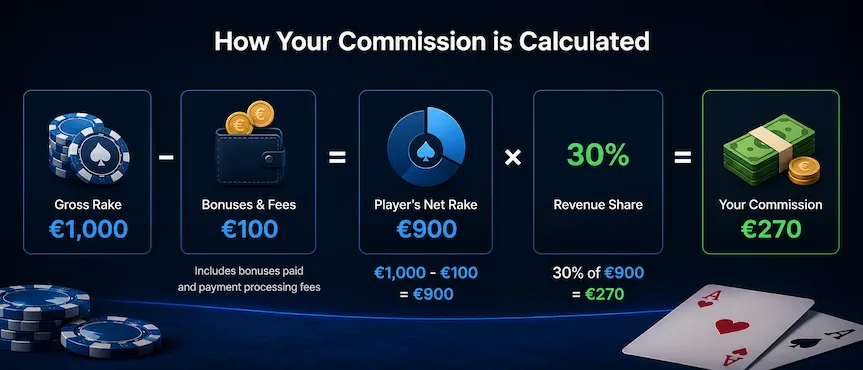
Let’s assume an affiliate has referred one new player to a poker site and the referral has generated €1,000 in gross rake during a month. The poker room then deducts €100 in bonuses and payment processing fees. If the affiliate program pays 30% revenue share on net rake, we can calculate the affiliate’s earnings as seen in the image below.
Revenue Share, CPA, and Hybrid Deals
Online poker affiliate programs that use the Revenue Share (RevShare) model pay affiliates a percentage of the rake generated by players, with rates often ranging from 20% to 45%. This commission model allows affiliates to earn lifetime income as long as their referrals remain active and generate eligible rake.
On the other hand, affiliates on a program that uses the Cost Per Acquisition (CPA) receive upfront cash based on a specific activity or qualification threshold. For example, they can be paid a one-time flat fee for every new player or first-time depositor referred to a poker site.
Hybrid deals combine CPA payments with ongoing revenue-share percentages, balancing immediate income with long-term earnings. Poker rooms with hybrid commission models typically target affiliate marketers seeking more predictable cash flow and recurring revenue from high-value poker players. They also appeal to affiliates with different business models.
The exact qualification criteria vary from one operator to another, depending on the affiliate agreement. Many operators require referred players to generate a minimum amount of rake within a specified period for affiliates to qualify for hybrid payments.
Negative Carryover, MGR, and Deductions
Negative carryover, monthly gross revenue (MGR), deductions, and other agreed adjustments are among the most important factors every poker affiliate must consider. Affiliate programs with a negative carryover policy carry over losses from one commission period to the next one if referred players win more money than they generate for the operator. While negative carryover is less common in poker than casino and sports, it can still appear in the T&Cs. Therefore, you should always read the terms.
MGR is the starting revenue figure used to determine a marketer’s affiliate earnings in a given month. It is the revenue generated by referrals before deducting bonuses, rakeback, promotions, payment processing fees, and admin fees. An affiliate’s revenue share is calculated on net gaming revenue (NGR) after all deductions are applied.
Why Poker Affiliation is Different from Casino and Sportsbook
While there are notable similarities with casino affiliate programs and other online gambling products, poker behaves differently. Understanding the difference changes how an affiliate marketer in the poker niche selects a program and the methods they can choose to drive traffic to gaming sites.
Limited Rooms, Shared Liquidity, and Network Skins
Unlike traditional online casinos, there is a limited number of poker rooms because players need opponents to play. Liquidity is the product and a crucial aspect of poker. A poker room with many active players appeals to gamers with bigger tournaments and higher table stakes. This creates a network effect, as the poker room value grows exponentially with popularity.
The most dominant poker rooms draw in players who want to play immediately since the games are already running. Moreover, many poker rooms are actually skins on a shared network, allowing multiple brands to run simultaneously and carve out their own market share. At the same time, the competition for network traffic can be fierce. An affiliate who uses online poker affiliate programs to promote rooms with thin traffic may have difficulty retaining players.
Player Ecology and Long-Term Value
Player ecology in gaming rooms refers to the state of distribution among various categories of poker players. A healthy number of recreational players in an online poker room is one of the primary factors affecting rake. The best online poker room operators always seek an optimal balance between recreational and regular players.
Regular players are a high-value category because they are likely to spend significant amounts of money and enjoy longer playing sessions. When looking for the best poker affiliate networks and programs, affiliates should consider this metric, as a good balance between different types of players can help maximize rake generation over time. This results in sustained passive income for affiliate marketers in the poker niche.
How to Evaluate a Poker Affiliate Program
The search for competitive deals in a world with many options for online poker affiliate marketers requires careful consideration of several important factors. Below is Gaffg’s practical checklist ordered based on what affects your affiliate earnings.
Commission Terms and Hidden Deductions
When looking for the best poker affiliate programs, don’t focus solely on the operator’s headline commission rate. You should read the terms and actively assess the following aspects.
- Revenue Share Tier: Confirm whether higher commission rates are tied to first-time deposits by new players, rake, or monthly revenue. Ask what it takes to maintain high commission percentages and whether tiers reset each month.
- CPA Thresholds: Find out the program’s criteria for players to qualify for CPA payments. For example, the requirement could be a player’s first deposit or a minimum amount of generated rake.
- Commission Deductions: Identify deductions that can reduce your revenue, such as bonuses, fees, taxes, and chargebacks.
- Minimum Activity Quotas (MAQ): Establish whether you must bring in a minimum number of new customers or generate a certain amount of revenue each month to maintain your commission or continue participating in the program.
- Dormancy and Inactivity Clauses: Find out whether the program will reduce your commission or suspend/close your account if you stop sending affiliate traffic.
- Operator's Right to Modify Terms: Carefully read the agreement to establish whether the operator can modify commission percentages, payment terms, qualifying criteria, or program policies at their discretion.
Reporting, Tracking and Data Access
Reliable poker affiliate marketing programs ensure transparency and data reliability by providing affiliates with real-time statistics and tracking via APIs. Marketers can use APIs to pull data and manage multiple brands or large traffic volumes. Additionally, postbacks (server-to-server tracking) automatically notify you when a player completes an action.
By choosing a program with sub-ID tracking, you can use links with unique identifiers to track performance and determine exactly where valuable players originate. Dynamic variables, on the other hand, play a crucial role in identifying campaigns with the most valuable poker players.
Reporting systems help affiliates track their performance and analyze all the data about new players, deposits, active customers, and revenue generated. However, delayed reporting makes it difficult to optimize marketing campaigns.
Reputation, Payments, and Manager Support
Reputation is another important consideration for marketers searching for reliable poker affiliate programs. To find operators with a positive reputation, you must assess their track record, feedback from online communities or users, and transparent terms and conditions.
Trustworthy programs also have timely payments for affiliates and sub-affiliates who meet all requirements. Affiliates can determine each program’s payment reliability by assessing the available banking methods, schedules, minimum withdrawal thresholds, and GEO-friendliness.
Access to effective marketing materials and a knowledgeable affiliate account manager are other crucial factors to consider before joining any poker affiliate program.
Choosing the Right Commission Model for Your Traffic

The right affiliate program for promoting online poker games offers a commission model that matches your traffic and cash-flow needs. Revenue share is the most appropriate option if you operate a well-established content or SEO-based poker affiliate site with long-term traffic. However, you need to be patient because you are unlikely to generate profits immediately.
If you focus on high-volume, paid, or campaign-based traffic and you wish to reinvest upfront cash, consider a program with the CPA commission model and choose hybrid if you want to hedge. Note that you can also negotiate better deals with your affiliate manager if you have proven traffic.
Traffic Sources that Convert in Poker
Unlike other verticals, traffic in poker affiliate marketing is more content- and community-driven, and the right program or model depends on your channel.
SEO and Strategy-Led Content
Strategy, guides, tools, and reviews are the four most common content types that consistently attract qualified traffic in poker affiliate search engine optimization (SEO). Strategy content attracts players who want to learn how to play poker and improve their skills. How-to content helps convert an intent-driven audience into valuable players by answering practical questions and providing step-by-step solutions. From an SEO perspective, poker educational content creates opportunities to capitalize on long-tail educational searches with lower keyword competition.
Communities, Streaming, and Video
Community-led channels are among the most effective ways to promote online poker sites. Widely used options include online forums, staking and backing communities, podcasts, newsletters, live streaming, and YouTube videos. Due to poker’s strong community culture, players can interact to share strategies, review poker rooms, or discuss hands. As a result, community-led channels can be reliable sources of affiliate traffic that reinforce an affiliate website’s authority. The best poker affiliate networks also offer a wide range of promotional tools for marketing poker offers, including banners, custom creatives, and tracking links.
Regulation, GEO-Targeting, and Crypto Poker Rooms
National and global regulations determine where and what you can promote. Some poker rooms or operators are GEO-restricted, meaning that affiliates cannot market them in certain jurisdictions. Such restrictions prevent players outside allowed jurisdictions from signing up, depositing money, or playing poker games.
Since poker requires opponents, GEO-restrictions highly affect player pools. Affiliate marketers cannot use promotional materials to generate traffic from players in countries where poker rooms are prohibited. Moreover, certain compliance responsibilities are passed down to affiliates, such as marketing rules, restricted countries, and responsible gambling requirements.
Important Notice

Final Thoughts on Poker Affiliate Marketing
All in all, these deals are among the popular gambling affiliate programs that provide an opportunity to earn money by referring players to poker sites. Marketers can profit if they understand what rake is, choose recognized affiliate marketing programs with transparent T&Cs, use a commission model that fits their traffic, create durable content, and utilize community-led channels.
While poker is a slower and more difficult vertical than casino, affiliates benefit from player loyalty and lighter competition. Publishers should select well-established and reputable poker networks to avoid operators with a bad reputation that can ruin affiliate businesses. Use our listing to compare various poker affiliate programs and check out our reviews to learn more.