
RevShare Deductions: Admin Fees and Bundling Explained
Admin Fees, Bundling, and the RevShare Deductions That Quietly Kill Affiliate Earnings

We are now expanding into B2C, publishing player-facing casino reviews and category pages for players across international markets.
The two sides feed each other. We know exactly how these bonus terms are drafted before they are published on the bonus page. We know why a withdrawal request which should take ‘1–3 days’ to process can remain in the ‘manual review’ stage for a whole week. We are aware of what goes on behind the scenes when you receive a KYC alert.
That is why, when we review a casino, we don’t just look at its homepage. We also scrutinise the small print. We read through the entire terms and conditions and the cashier section, as we know the summary rarely tells the whole story.
On every page, you will notice we hold ourselves to the same standard. We answer your questions directly. We state findings, not opinions. And we don’t sugarcoat anything just to make a casino look good. We call out limitations that could catch you off guard.
Whichever side of the industry you are on, we hold every page to the same standard and we don't sugarcoat anything to make a casino or a programme look better than it is.
Ask ten affiliates what RevShare rate they signed, and they will probably give you a number. Ask what they actually take home as a percentage of gross gaming revenue, and most go quiet. That gap between the rate on the deal sheet and the money that lands in your account is where RevShare deductions start to matter.
Admin fees, bonus costs, bundling, processing charges, and other deductions can turn a confident headline percentage into something considerably smaller, month after month, for as long as the deal runs. This guide explains that deduction chain: what each cost is, how it affects your effective commission rate, and what to ask an affiliate manager before sending a single click.
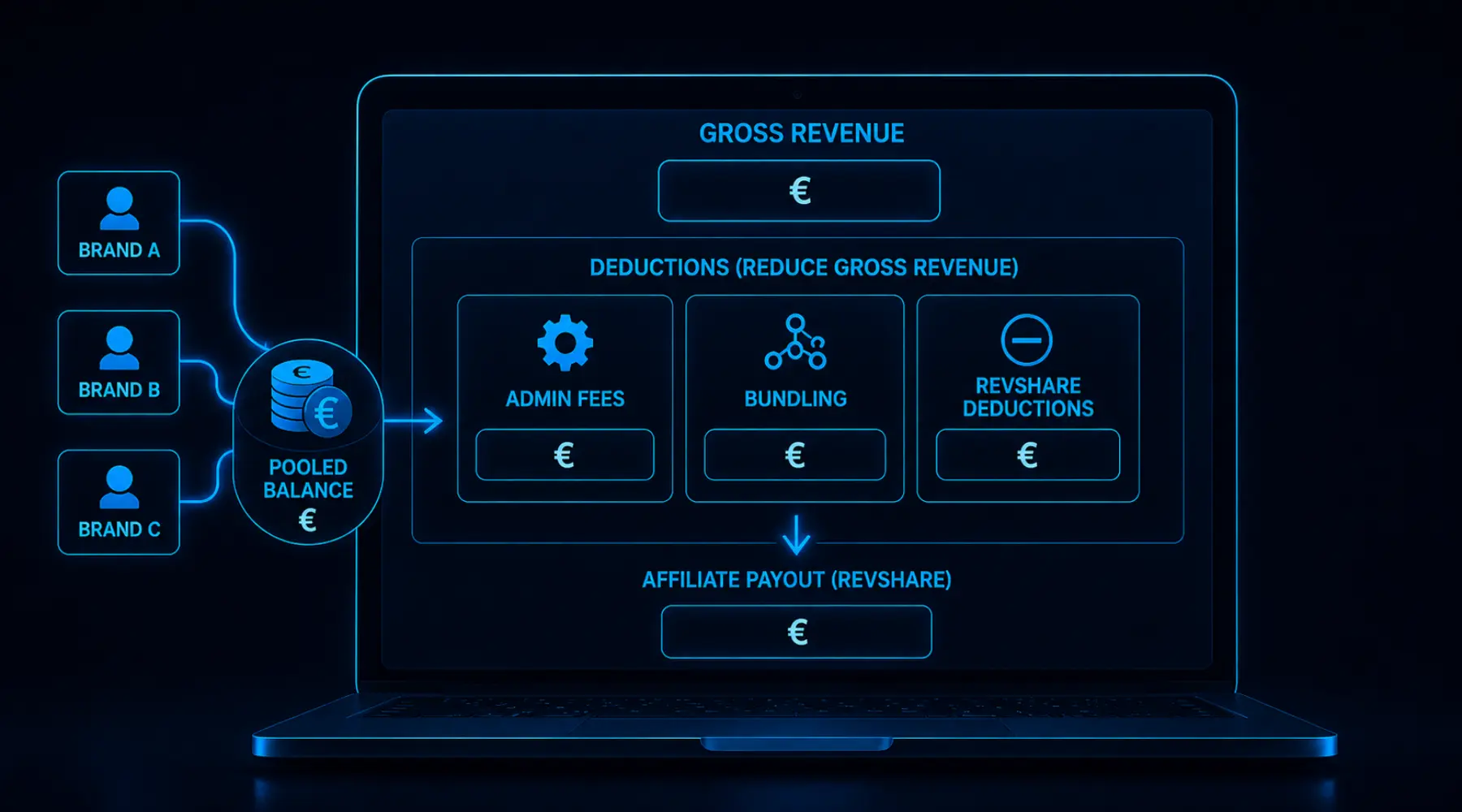
How RevShare Deductions Reduce Your Real Commission Rate
Let’s look at an example. Say your referred players generate €10,000 in GGR for the month. You are paying a 40% RevShare.
You would think your commission would be €4,000. Right? Wrong. The commission is typically paid after multiple deductions have been taken.
|
Line item |
Amount |
|
Gross gaming revenue (GGR) |
€10,000 |
|
Bonus costs |
−€1,200 |
|
Payment processing, provider royalties and jackpot contributions |
−€800 |
|
Admin fee at 10% of GGR |
−€1,000 |
|
Net gaming revenue (NGR) |
€7,000 |
|
RevShare rate |
40% |
|
Your payout |
€2,800 |
|
Effective rate against GGR |
28% |
|
Expected payout at 40% of GGR |
€4,000 |
|
Monthly difference |
€1,200 |
In this example, your 40% is taken against €7,000 of NGR rather than €10,000 of GGR. You therefore receive €2,800, meaning your effective take rate is 28% of gross revenue.
The important thing to understand is that a 40% deal can pay you less than a 30% deal if it operates under a heavier deductions model. A headline percentage in your contract is useless until you know what it applies to, as well as all of the costs deducted against BEFORE they hit that base.
How Net Gaming Revenue Is Calculated
RevShare is typically calculated on net gaming revenue (NGR). This is calculated by deducting an agreed list of operating costs from gross gaming revenue. Examples of deductions can include:
- Player bonuses and promotional credits
- Gaming taxes and regulatory fees
- Payment-processing fees
- Game provider royalties
- Jackpot financing
- Chargebacks and fraud
- Operator fees
NGR formulas vary between operators, as there is no single formula across the online gambling industry. So two programmes with the same headline rate could potentially pay out very differently with the same amount of player activity. Be sure the agreement clearly defines each deduction. Vague language like “operation costs” or “other expenses” can leave too much discretion to the operator.
Why the Order of RevShare Deductions Matters
If you accept a revenue share, order of deductions matter for how much you get paid. As noted in the numbers above, 10% admin fee of €10,000 GGR is €1,000. Subtract €2,000 of bonuses / other deductions, then calculate your fee and you’re paying €800.
This can result in a significant loss over time, more so as you scale to larger volumes. Always ask for a formula written out that specifically states EACH deduction, what gets calculated against, what order they are applied in and if total deductions ever reach a cap. You’ll otherwise have nothing to work off of when trying to see if a deal is beneficial for you.
How Admin Fees Affect RevShare Earnings
Admin fees are one of the deductions you should always check most closely. This is because they’re usually given as a single percentage figure with little or no explanation of how this percentage is worked out. An admin fee may be listed as 10%, 20% or higher on a programme. But the percentage alone doesn’t reveal:
- Whether it is calculated against GGR or a reduced revenue figure
- Whether it applies at account, brand or player level
- Whether it affects both positive and negative player results
- Whether it is included alongside separate processing and provider fees
- Whether the operator can change it later
Affiliates should therefore ask for more than the stated percentage. They need the full calculation method.
Symmetric vs One-Sided Admin Fees
Ask whether the admin fee also deducts from player wins. Symmetric fees linearly decrease your prize pool. One-sided fees reduce positive NGR more than they increase negative balances. Symmetric fees become even harsher with negative balances. Compare your monthly player activity estimates to the dashboard. Look for differences that aren't related to the deductions listed above.
How Bonus Costs Are Deducted From NGR
Bonuses such as welcome packages, reload bonuses, free spins, and promotional credits may be deducted out of a player's gross revenue before that player's RevShare is calculated. If your bonus costs are high enough, bonus percentages can drastically affect high rollers because the higher the bonus allowed on their play, the lower the NGR that is earned from that play.
- Which bonuses are deductible
- When the deduction is recorded
- Whether bonuses are valued at face value or actual cost
- How expired, forfeited, or uncleared bonuses are treated
- Whether unused promotional funds are credited back
Face Value vs Actual Bonus Cost
Some programmes will instantly deduct 100% of a bonus’ face value as soon as it’s awarded. For instance, if €500 is credited to a player’s account but wagering requirements aren’t met, the €500 could be deducted from NGR. Enquire about how bonuses are valued and whether forfeited or unused bonuses are returned to the pool. An equation should be transparent and account for the operator’s true cost instead of summarily deducting the full advertised amount.
What Is Bundling in a RevShare Agreement?
The term "bundling" is used in affiliate marketing to describe revenue streams/results that have been combined, which otherwise would have been tracked separately. Activity can commonly be bundled between brands, products, groups of players, or the whole affiliate account level.
Cross-Brand Bundling
If you are running more than one brand with the same operator, you should find out if commissions are stacked (bundled) together from all brands you promote. Using the example above, if Brand A had €5,000 positive NGR but Brand B had €5,000 negative generated revenue, they would both cancel each other out, leaving you with no commission to payout.
Always check with your operators if brand results are kept separate or pooled together. You should also check if negative balances can bleed between brands or if they can be rolled over into future months.
Pooled or Cohort-Based Deductions
Just like brand bundling, cohort pooling takes margins such as chargebacks, fraud adjustments and bonus abuse losses and spreads the deductions out across a large pool of referred players. Player-specific deductions are not applied to the player they originated from. Where someone has pooled deductions at a large level, it can make individual deductions difficult to audit. Just one problematic player can tank the NGR of otherwise unaffected and profitable players in the same cohort.
Always ask operators if deductions are calculated on a per-player, per-brand, per-product, or per-country basis or if they take it right back to your entire affiliate account. The smaller the number of players each deduction gets spread across, the easier it will be to audit where each deduction came from.
How Negative Carryover Compounds RevShare Deductions
Instead of merely prolonging the agony of a negative balance by moving that balance forward to be deducted from future earnings, negative carryover combined with deductions such as one-sided admin fees or cross-brand bundling will multiply the total amount withheld from player payouts. Negative carryover moves a remaining negative balance forward into future periods. Let’s say your account is −€3,000 at the end of month one, and you generate €4,000 of positive NGR for month two. You would only be able to share €1,000 of that €4,000 because your negative carryover balance gets deducted first. Instead of making €1,600 on a 40% RevShare, you would make €400.
Be sure to clarify if there is a negative carryover or not, how often balances roll over, if the carryover is calculated by player, by brand, or by account, and how carryover treats suspensions or terminations. Ideally, there would be no negative carryover, and the balance would reset to zero at some interval mutually agreed upon by both parties. This may be negotiable.
Other RevShare Deductions to Check
Admin fees, bonuses, and bundling are by far the most common deductions, but there are a few smaller ones that catch people out.
Payment-Processing Fees
Operators may charge fees for deposits, withdrawals, currency exchanges, use of digital wallets, cards or other payment methods. Check if the programme allows deduction of the true cost to the operator for each transaction or charges a flat percentage against all player transactions.
Game-Provider Royalties
Some casino game providers are compensated with a percentage of their games revenue, or some other usage-based metric. Affiliate programmes will often bundle these fees into their NGR. Since this deduction will vary based on which games are played, effective commission rates may differ for slots, live casino games, and jackpot games.
Jackpot Contributions
Whenever the online casino operates progressive or network jackpots, the operator may be required to pay a percentage of each wager to the jackpot prize pool. Like game-provider royalties, these contributions are usually deducted before calculating your affiliate commission. Make sure both the jackpot contribution and the eventual jackpot payout affect your account.
Regulatory and Gaming Taxes
Every jurisdiction taxes gambling operators differently. Taxes are sometimes deducted before commissions are calculated on a percentage basis. If you promote one operator in two countries, you could have extremely different effective commission rates while selling the same offer. Ask if tax rates are deducted based on player location and if you will be able to see those rates in your dashboard.
Chargebacks and Fraud Adjustments
Chargebacks, fraudulent reversed deposits, etc., are often deducted from NGR. The crucial point is whether the deduction is charged back to just the offending player or spread across a group of players. Affiliates should also see if previously settled periods can be reopened or adjusted.
Dynamic RevShare Rates
A dynamic rate will fluctuate based on performance metrics such as number of depositing players, monthly NGR, traffic quality or retention. Essentially this means the % offered at signup won't necessarily be set in stone. Key points to look out for include:
- The minimum requirements for each rate
- Whether the rate can move down as well as up
- How often performance is reviewed
- Whether one weak month triggers an immediate reduction
- Whether the operator can change the thresholds unilaterally
Any clause that allows the operator to modify the commission rate/deduction structure without notice should be considered a red flag.
What to Check Before Signing a RevShare Deal
The headline rate should just be one factor in your comparison. Ask for enough information to recreate the commission calculation yourself before you start sending traffic.
Here's what to ask for:
- Itemised NGR formula. Every deduction category should be clearly identified, including the calculation base and sequence of deductions.
- Itemised admin fee calculation. Verify the percentage, if it's taken against GGR or NGR, and how it is applied during positive and negative months.
- Bonus cost policy. Verify whether bonuses are deducted at cost or face value. What happens when bonus funds are unused? What happens when they are forfeited?
- Bundling rules. Verify whether performance is pooled across brands, products, countries, players or entire affiliate accounts.
- Negative carryover terms. Determine whether negative balances roll over and, if they do, what is the reset period.
- Cap on deductions. A hard limit can keep operating costs from eating up most of your revenue.
- Per-player reporting. Your dashboard should provide enough data granularity to reconcile traffic to revenue, bonuses paid, fees taken, adjustments and final NGR payout.
- Notice period of changes. The agreement should state whether commission rates can be changed by the operator as well as how much advance notice is required.
- Audit rights. There should be an established method for questioning calculations and accessing data used to support them.