
Affiliate Programs are Quietly Tightening Negative Carryover Terms in 2026 — Here’s Why
Negative carryover (NCO) has always been one of the most debated clauses in affiliate agreements, but 2026 marks a noticeable shift. Some iGaming affiliate programs that have previously promoted their “no negative carryover” policy as a benefit publishers can capitalize on have quietly adjusted T&Cs, introducing stricter rules. For affiliates, this is a critical issue because NCO can reduce their RevShare by a significant amount. A high RevShare percentage advertised by the program is meaningless if the affiliate’s profits are constantly threatened by negative carryover.

We are now expanding into B2C, publishing player-facing casino reviews and category pages for players across international markets.
The two sides feed each other. We know exactly how these bonus terms are drafted before they are published on the bonus page. We know why a withdrawal request which should take ‘1–3 days’ to process can remain in the ‘manual review’ stage for a whole week. We are aware of what goes on behind the scenes when you receive a KYC alert.
That is why, when we review a casino, we don’t just look at its homepage. We also scrutinise the small print. We read through the entire terms and conditions and the cashier section, as we know the summary rarely tells the whole story.
On every page, you will notice we hold ourselves to the same standard. We answer your questions directly. We state findings, not opinions. And we don’t sugarcoat anything just to make a casino look good. We call out limitations that could catch you off guard.
Whichever side of the industry you are on, we hold every page to the same standard and we don't sugarcoat anything to make a casino or a programme look better than it is.
What Negative Carryover Actually Means (A Quick Refresher)
Commissions under the revenue share (RevShare) model are paid based on the operator’s Net Gaming Revenue (NGR). If a referred player has a high win rate, the NGR can be negative for the month. Whether or not this negative amount will carry over to the following month depends on the negative carryover policy.
With NCO, you can have an NGR deficit, meaning the commissions will be zero until the deficit is paid off. With no negative carryover (NNCO), on the other hand, the negative value is reset to zero at the beginning of the next month.
|
Aspect |
With Negative Carryover |
No Negative Carryover NNCO |
|
Deficit treatment |
Negative NGR rolls into the next period |
Balance resets to zero each period |
|
Next month's payout |
Suppressed until the deficit clears |
Paid on current performance immediately |
|
Who absorbs big-win risk? |
The affiliate |
The operator |
|
Typical positioning |
Common default; increasingly enforced |
Marketed as a perk — now being walked back |
Why Affiliate Programs are Tightening NCO Terms in 2026
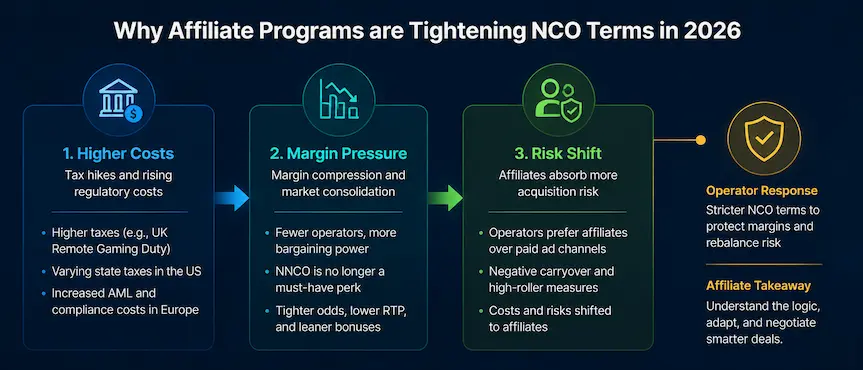
The tightening of NCO terms is not a random, malicious intent to cause harm but a response to a combination of factors that have put a strain on operator margins across the board. For example, higher compliance costs and tax hikes have forced even the best affiliate programs to reassess the risks. While most of these pressures are not mentioned in the affiliate agreements, they have significant effects on the terms offered to publishers.
Tax Hikes and Rising Regulatory Costs
Higher costs are the biggest source of pressure for many affiliate programs today. In the United Kingdom, Remote Gaming Duty increased from 21% to 40% in April 2026, and 25% Remote Betting Duty is expected to take effect in April 2027. In the United States, the situation is also unfavorable, as some states have high taxes and rates vary by state. Moreover, anti-money laundering (AML) and compliance costs in Europe have surged in recent years.
When a large share of profits goes to the government, operators look elsewhere to recover their margins, including product, player value, and marketing budgets. RevShare affiliates fall under the marketing category, and operators protect their profits by passing on the cost burden to them, especially when players win big.
Margin Compression and Market Consolidation
Compressed margins and consolidation that has led to only a few prominent operators controlling a large share of the market have also contributed to tighter NCO terms. Consolidation has given operators more bargaining power because they don’t depend on any specific affiliate. When almost every business was competing for affiliates, operators would use NNCO promises to appeal to publishers.
However, market consolidation has made NNCO a less attractive perk, and operators can easily apply stricter terms. Affiliates continue to experience the impacts of strict NCO rules as tighter odds, trimmed return-to-player (RTP) percentages, and bonuses lower net gaming revenues.
Affiliates are Absorbing More of the Acquisition Risk
Many major online casino operators now prefer working with affiliates rather than paid ad channels that are ever tightening their advertising policies. At the same time, operators try to reduce their costs and mitigate their risks by redefining their relationships with publishers.
Negative carryover, high-roller isolation, and other measures allow operators to shift some of their expenses and risks to affiliates. Therefore, operators don’t seek to reduce their expenditures at the expense of affiliates but rather to rebalance the risks. Affiliates who understand this logic will find it easy to negotiate better deals.
How the Tightening Shows Up in the Fine Print
Sport betting and casino affiliate programs may not always announce changes to their negative carryover policies. They often update their NCO T&Cs, change default settings, or start enforcing existing clauses quietly. You may only realize it when your commission drops, so “quiet” is the keyword when it comes to NCO policy updates.
Here is how tightening appears in the terms:
- NNCO being removed or scoped down: Affiliate programs removing their no negative carryover clause or applying it to specific tiers and GEOs.
- Lower or vaguer high-roller isolation thresholds: Reducing the win level for triggering player isolation or an unclear high-roller definition that depends on the operator.
- Cross-product bundling/loss of ring-fencing: Losses in the casino, sportsbook, or poker rooms combined, meaning that a big win in one vertical reduces commissions for all verticals.
- Longer reconciliation windows and clawbacks: Paid commission reversed due to chargebacks, refunds, and fraud adjustments.
- Indefinite rollover vs. periodic reset: A deficit that never resets after many months or even a year, suppressing the affiliate’s earnings.
- Silence as a default-to-carryover: Affiliate agreements that do not mention NCO, allowing operators to dictate the terms at their discretion.
How to Protect Your Earnings Before You Sign or Renew
Operators are most likely to implement stricter affiliate program terms when you want to renew your contract or through quiet updates, not just when signing up. Our practical tips below cover both new deals and renewals.
- Read the NCO clause first, not last: Consider negative carryover one of your top three factors to consider, not just the headline commission rate.
- Ask for a sample NGR report and the exact deduction list: Obtain an NGR report to understand how a negative balance is created and its effects on your affiliate earnings.
- Negotiate a reset: If the operator does not promise NNCO, negotiate a monthly or quarterly reset to avoid indefinite negative balance rollover.
- Clarify high-roller isolation in writing: Confirm the qualifying thresholds for high-roller isolation and avoid policies that leave everything to the operator’s discretion.
- Insist on product ring-fencing: If possible, ensure that casino and sportsbook balances are treated separately so that losses from one vertical do not reduce the affiliate income generated by the other.
- Try to diversify programs and GEOs: Join multiple programs across different GEOs to avoid total dependence on a single operator for your affiliate earnings.
- Prioritize hybrid or CPA if retention is uncertain: If traffic quality is uncertain, choose hybrid or CPA commission models to avoid carryover risks.
The Bottom Line
The NCO tightening noted in 2026 is likely to become a norm rather than a one-time adjustment for casino, poker, and sportsbook affiliate programs. Stricter rules indicate a rational operator response to higher taxes, compliance costs, and other factors that affect margins. Affiliates must accept the fact that the pressure is most likely to continue. To protect your affiliate income, you must always read the fine print, not just the headline commission rate. We also recommend working closely with operators to negotiate favorable carryover, high-roller isolation, and reset rules.