
How Prediction Markets are Eating into Sportsbook Affiliate Traffic
Prediction markets have reached a mainstream moment, with leading platforms like Polymarket and Kalshi recording high trading volumes and sports becoming the most popular choice among users. What was initially a niche market is now competing for the same audience that sports betting platforms have spent years attracting. For affiliate marketers, webmasters, and affiliate managers who need to know where the traffic is going and respond accordingly, this shift has significant implications. A proportion of the traffic and attention directed towards traditional sportsbook affiliate channels is being diverted towards prediction-market content. As prediction markets gain acceptance, they have started to appear in sports betting SERPs for the same queries.

We are now expanding into B2C, publishing player-facing casino reviews and category pages for players across international markets.
The two sides feed each other. We know exactly how these bonus terms are drafted before they are published on the bonus page. We know why a withdrawal request which should take ‘1–3 days’ to process can remain in the ‘manual review’ stage for a whole week. We are aware of what goes on behind the scenes when you receive a KYC alert.
That is why, when we review a casino, we don’t just look at its homepage. We also scrutinise the small print. We read through the entire terms and conditions and the cashier section, as we know the summary rarely tells the whole story.
On every page, you will notice we hold ourselves to the same standard. We answer your questions directly. We state findings, not opinions. And we don’t sugarcoat anything just to make a casino look good. We call out limitations that could catch you off guard.
Whichever side of the industry you are on, we hold every page to the same standard and we don't sugarcoat anything to make a casino or a programme look better than it is.
Why Sports Bettors are Trading, Not Just Betting
The appeal of prediction markets lies in their unique approach to wagering. Instead of betting against a bookmaker, traders can buy and sell “yes” or “no” contracts on an exchange platform, with probabilities built into the price.
Many sports bettors are attracted by the perception that prediction markets offer tighter pricing than sportsbooks. Because the collective sentiments of users determine prediction market prices regarding the likelihood of a “yes” or “no” outcome rather than bookmaker margins, many punters believe that market prices indicate an event's true probability.
Accessibility in regions where sports betting sites are not live is another reason why many bettors participate in trading. For example, regulated prediction markets can now offer their services to traders in the United States, covering a wide range of markets, including politics, sports, pop culture, and elections. Sports betting has become a popular category on such sites, leading to overlapping audiences. The growing user interest has driven a surge in related searches, and that’s where affiliate traffic begins to shift.
Where Sportsbook Affiliates are Actually Losing Traffic
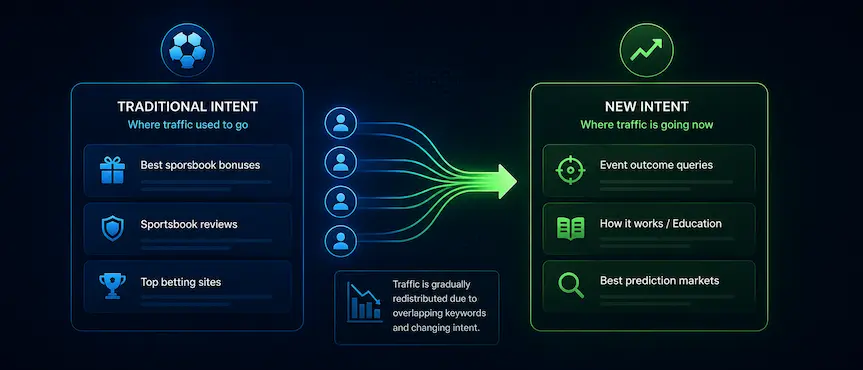
The growing interest in prediction markets doesn’t translate to a dramatic loss of traffic for affiliates who focus on directing bettors to online bookmakers. Instead, it is a gradual redistribution across search intent, search results, and informational queries.
Some of the traffic that would traditionally go to sportsbook affiliates now goes to prediction market platforms because of changing user intentions when comparing bookmakers and researching how prediction betting works. The sections below explain two different ways in which affiliates in the sports niche are losing traffic to prediction markets.
Search and Keyword Overlap
An increase in SERP-level competition is a notable shift, as the marketing content created by prediction market publishers and platforms now ranks for keywords that used to be dominated by sports betting affiliates. Some traffic goes to prediction markets instead of sportsbook affiliates because search engine results pages show relevant articles for the same queries.
For example, prediction-market content ranks for odds-comparison intent and event-outcome queries, such as “who will win” a particular event. Moreover, the number of branded “Kalshi/Polymarket + [sport]” searches has increased in recent years.
Well-funded prediction markets and super-affiliates are also investing heavily in content explaining “how it works” and the “best prediction markets” today. Such pages are gradually crowding information on SERPs.
This doesn’t necessarily mean that an affiliate's sportsbook content will completely disappear from search results. Instead, both prediction markets and sportsbook affiliates share competing content. Even if a sports betting affiliate still ranks well in SERPs, additional prediction-market results that appear when a user searches for a sportsbook can reduce click-through rates.
The Intent and Education Gap
The traffic shift is not only about keyword ranking for a specific search query — it also concerns a notable change in user intent. Many searchers are no longer asking “where do I bet?” They have now shifted to “what is this/how does it work/is it legal?” mode. Many sportsbook-focused affiliate pages don’t address such questions, creating an opportunity for prediction-market content to capture those clicks.
This education gap is one of the clearest openings that prediction platforms alone cannot fill. Affiliates can capture intent that sportsbook-focused content misses by creating clear, explanatory content that addresses the growing number of informational queries.
How to Spot the Shift in Your Own Numbers
Before an affiliate changes their strategy to avoid losing traffic to prediction markets, they should first establish whether these platforms are actually affecting their traffic. This self-diagnosis phase is all about separating a genuine shift in user intent from seasonality and normal fluctuations around sporting events. The tools needed at this point include analytics, a rank tracker, and search consoles.
Start by examining your analytics and search performance data. Crucial signals include declining impressions or clicks on sports and event-outcome keywords that were initially performing well. After that, use a ranking tool to check whether prediction markets and related affiliates are appearing alongside your sports affiliate content in search results.
Next, use a search console to check for increasing demand around brand-name terms in your target market. If you come across ranking informational content with falling click-through rates, it means that users are probably choosing different search results.
Once you spot the shift, you can decide how and where you need to adapt your affiliate content strategy to cover the gap.
Turning the Traffic Shift into an Affiliate Opportunity
iGaming affiliate programs can benefit from the traffic shift only if they treat prediction markets as a new, legitimate vertical to cover, not a rival to fight. With a small number of specialized affiliates, a clear education gap, and platforms actively seeking publishers to partner with, the prediction sector is still growing.
It creates a genuine first-mover opportunity for affiliates who want to learn and venture into the market early. The opportunity comes in two ways: creating affiliate marketing content that covers prediction markets and evaluating program economics.
Build Prediction-Market Coverage into Your Content Mix
Bettors looking for prediction markets typically enter through education-intent searches. Therefore, sportsbook affiliates should focus on answering their questions before marketing their offers. Clear, useful information helps publishers build trust and capture users during the early stages of their decision journey.
Affiliates should cover prediction markets through these content opportunities:
- Create “how prediction markets work” and “how they differ from a sportsbook” explainers using plain English.
- Publish legality and availability guides by state or jurisdiction and update the content accordingly as laws and regulations change.
- Use side-by-side “prediction market vs sportsbook” comparisons for specific event types.
- Prepare news-reactive pages covering major sporting and cultural events that increase trading on prediction platforms.
- Create how-to-get-started guides explaining the deposit process, contract pricing, and settlement terms.
Because this is a news-driven niche, user interest can shift drastically around events and market launches. Affiliates should avoid “set and forget” content because it is unlikely to perform. They should regularly update pages to reflect what users are currently searching.
Weigh Up the Affiliate Program Economics
Promoting sportsbooks and prediction markets requires a clear understanding of the affiliate program economics—and it's worth reading the affiliate agreement carefully before signing so the terms match your expectations. The table below compares both options.
|
Factor |
Sportsbook Affiliate Programs |
Prediction Market Affiliate Programs |
|
Maturity |
Established with many affiliate programs available |
Growing with fewer affiliate programs |
|
Commission Models |
CPA / RevShare / hybrid |
Typically CPA or volume-based, still evolving |
|
Geo Reach |
Licensed states/markets only |
Broader national reach (particularly US) |
|
Keyword Competition |
Saturated |
Opening, less crowded |
|
Content Angle |
Conversion-led |
Education-led |
As prediction markets continue to evolve, platform operators are expected to learn player value and offer better commission deals. Early partners are choosing to get started while the industry is still in its growth phase.
Final Words — Ride the Shift, Don’t Resist It
Prediction markets present a new vertical that, instead of replacing sportsbook affiliate traffic, reshapes where attention goes across the broader iGaming industry. Affiliates who are most likely to benefit from this shift are those who audit their data and adapt their marketing content to capitalize on emerging opportunities in prediction markets.
Rather than focusing on or abandoning sportsbook coverage, they should expand into adjacent areas, fill the education gap, and create helpful resources for users discovering prediction markets for the first time. This is still a young market, so affiliates can expect regulations, platform strategies, and partnership models to evolve.