
The Rise of AI Dealers: Are Live Casino Studios Actually Cutting Costs?
AI dealers turned from a novelty at a trade show to a genuine business boardroom discussion in less than a year. The pitch to operators has always been focused on cost-cutting. When the co-founder of FanDuel, Nigel Eccles, starts transforming the entire company around AI croupiers, the industry sits up and listens. The costs that are cut aren’t always obvious, or, in many cases, even real. The value proposition is inflated, and the costs moved, but not disappeared, from one line of the budget to another. In this article, we attempt to highlight the hidden trade-offs of using AI dealers to help operators and affiliates calculate their potential benefits.

We are now expanding into B2C, publishing player-facing casino reviews and category pages for players across international markets.
The two sides feed each other. We know exactly how these bonus terms are drafted before they are published on the bonus page. We know why a withdrawal request which should take ‘1–3 days’ to process can remain in the ‘manual review’ stage for a whole week. We are aware of what goes on behind the scenes when you receive a KYC alert.
That is why, when we review a casino, we don’t just look at its homepage. We also scrutinise the small print. We read through the entire terms and conditions and the cashier section, as we know the summary rarely tells the whole story.
On every page, you will notice we hold ourselves to the same standard. We answer your questions directly. We state findings, not opinions. And we don’t sugarcoat anything just to make a casino look good. We call out limitations that could catch you off guard.
Whichever side of the industry you are on, we hold every page to the same standard and we don't sugarcoat anything to make a casino or a programme look better than it is.
From Novelty to Industry Shift: Where AI Dealers Stand in 2026
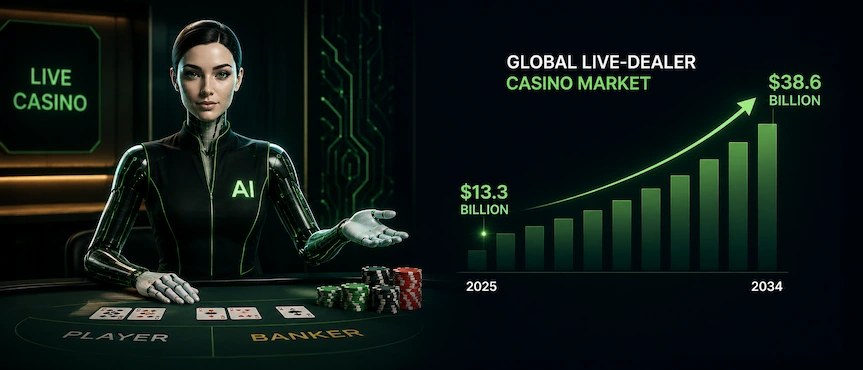
An AI dealer is a virtual croupier that is controlled by real-time processing and natural language as opposed to the pre-set routines or animated hosts that have been traditionally used. The fundamental difference is that it is interactive in real-time and can respond to the context of the table and the behavior of the players rather than following a pre-set pattern. This is an important distinction from a business perspective, as it is the key innovation that allows operators in the online gambling industry to replace human dealers.
The market potential is no longer hypothetical, as there are already companies that are considering the switch, while the surrounding market is large enough that any reduction in costs is welcome. The global live-dealer casino market was around $13.3 billion in 2025 and is projected to reach about $38.6 billion by 2034. This means that for such a market, the cost of production in the form of live-studio dealers is a significant expense, so any innovation that can reduce it is of interest to the market players.
The Companies Betting Big on AI Dealers
This is a real market with several named players, not one startup's hype cycle, and their AI dealer demos have become a fixture at the major iGaming conferences where operators scout new tech.
- Sentient Studios was spun out of crypto casino BetHog by FanDuel co-founder Nigel Eccles. BetHog is shutting down its B2C crypto casino on 31 July 2026 to focus entirely on the Sentient Studios B2B AI dealer business, and the company raised a $10 million Series A to roll the platform out to third-party operators.
- Avanti has been active on the partnership front, including work with Entain, and is one of the vendors publishing the sharpest cost comparisons.
- QTech Games is adding deeper AI realism to its live suite through the Sentient Gaming Group, extending the technology across its distribution network.
- Evolution, the category leader, is embedding AI across its roadmap but stopping short of fully replacing human dealers, a stance that reads as both caution and product conviction.
The Cost-Cutting Promise: Why Operators are Interested
For online casinos, the bull case is predicated upon a massive reduction in costs associated with conventional forms of live dealer tables. Evolution has revealed that approximately 88% of its staff are engaged in the services of table hosts and dealers. This is one of the largest operating expenses for the company, and this factor has been targeted by vendors which offer AI-based solutions, as reducing the number of employees involved in game dealing operations reduces costs by over 80% of the initial value, which makes the vendor’s solution considerably more attractive from a financial standpoint.
Another factor concerns the change in the business model. The vendors which provide AI-based solutions are positioning their services as a revenue-share tool, which involves no initial costs and only requires payments to be made if tables at the host’s venue register any revenues. This is particularly advantageous for companies which are considering the adoption of live casinos but are hesitant to commit to large expenditures. The switch to such a business model drastically reduces the risks associated with the launch of the service.
The table below presents the differences in revenue shares provided by vendors on the example of Avanti’s proposals.
|
Cost factor |
Traditional live dealer table |
AI dealer table (vendor figures) |
|
Studio buildout |
$300,000-$500,000 in development costs |
No physical studio; software deployment |
|
Staffing |
~40 dealers, $800,000-$1m in personnel costs |
No dealers, shifts, or benefits |
|
Scaling |
Setting up 100 tables costs roughly 100x one |
One table costs about the same to set up as a hundred |
|
Time to launch |
Months of build and hiring |
Weeks, software-side |
|
Cost model |
Upfront capex plus fixed payroll |
Revenue share, no setup fee, no minimum |
Where the Savings Come from
First, there is no need for a physical studio and associated capex. Analysts note that skipping the studio reduces time to market and lowers capital requirements, which is especially important in markets like the US, where new studios are expensive and time-consuming to open. Second, there is no need to pay salaries, organize shifts and breaks, or provide benefits to employees while securing the same level of 24/7 productivity.
Third, there is the ability to scale rapidly by provisioning additional tables without incurring significantly higher costs per instance. This is what makes the “it costs the same to provide 100 as 1” phrase so appealing.
Finally, there is the flexibility and speed of localization and adaptation. The ability to rapidly introduce a new language or make modifications to a table is much more valuable than relying on a slow and expensive supplier chain. That's the promise. We will see if these expectations are met with actual performance in due time.
Are They Actually Cheaper? The Hidden Costs
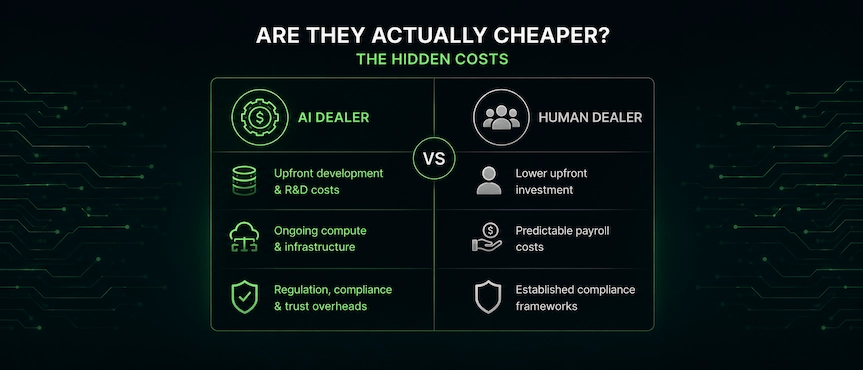
The savings are undeniably true, at least somewhere in the stack. The issue is that the cost-cutting narrative hides expenditures that have simply shifted location rather than vanished. Also, most of the evidence on which this narrative is based is from vendors. AI dealers may not actually eliminate expenditures, only relocate them. Who bears the costs and when is often more important than the fact that they exist.
Upfront Development and Compute Costs
The revenue-share pitch hides two large figures. One is the substantial R&D cost required to produce a sufficiently competent, situationally aware AI dealer. The second is the significant ongoing compute/infrastructure cost associated with rendering realistic real-time avatars at any decent scale, which ultimately has to be borne by somebody. With the revenue-share option, that “somebody” is the vendor, who effectively bundles the expenses into the cut he extracts from the operator’s gross revenue.
Meanwhile, the upfront cost of conventional tables is recouped over time via hourly wages. At a sufficiently large scale, a cut of the GGR (gross gaming revenue) from AI tables can greatly exceed the combined payroll of their human counterparts at the same venue. Further, the most popular claim that AI tables were “10x more popular than human dealers" was, notably, generated by the vendor and not an independent third party.
Regulation, Trust and Compliance Overheads
AI dealers pose regulatory and compliance challenges that add cost and complexity to the rollout. Fairness audits, licensing, and the need to maintain human oversight in case an AI ever needs to influence a game or its outcome add significant overheads. Regulators are not entirely clear on how a digital dealer can demonstrate the same level of verifiable randomness as actual physical equipment, and both regulators and players have concerns over personal data profiling.
At the same time, in highly regulated markets, the combination of the two can cut into the speed to market that the vendor promises, undercutting one of their main selling points. The simplest way to think about it is that the cost is not just financial – it also comes in the form of reputational damage and increased overheads due to the necessity to justify and prove the absence of unfairness at every stage to satisfy regulators.
Cost isn't Everything: The Human Element
Even if AI dealers are cheaper, are they better for the product? The incumbent counter-argument deserves a fair hearing. Evolution CEO Martin Carlesund has framed it with an analogy, asking whether, in ten years, films will be made only with AI or whether audiences will still want real actors. His point, using TikTok as evidence, is that "real" content wins attention and that authenticity is a feature players actively value rather than a legacy cost to be optimized away.
The vendor rebuttal is that modern AI dealers are situationally aware and dynamically responsive, not scripted, and that solving that responsiveness is precisely the hard technical problem they claim to have cracked.
However, human dealers still clearly win on social energy, on trust, and on the reassurance players get from watching physical equipment shuffle and spin. AI genuinely excels at speed, consistency, freedom from human error, and round-the-clock availability.
The likely outcome isn't a clean conversion but a split market: AI for scale, localization, and the long tail of low-traffic tables where a human host is hard to justify; and humans for premium, VIP, and trust-sensitive experiences where the personal touch is the product. Operators who treat this as an either/or decision will probably misread their own audience.
What This Means for Affiliates and Operators
For those who make commercial decisions, including operators and casino affiliate programs, the analysis translates into a short list of things worth checking before anyone signs a contract or writes a review. The cost story is only useful once it's tested against a specific audience, a specific market, and a specific volume.
- Affiliates: watch which new AI-dealer brands are entering the market and whether they differentiate on player experience or purely on price. A cheaper table that players avoid converts nobody.
- Operators, before signing: scrutinize the total cost over your actual volume, not the no-setup-fee headline. A revenue share can outrun fixed payroll on high-traffic tables.
- Compliance due diligence: confirm fairness auditing exists and that the AI dealer is accepted by the regulator in each target market before committing to a rollout.
- Player retention: establish whether your audience actually prefers AI or human dealers. VIP segments in particular may resist synthetic hosts.
- Competitive edge: the clearest advantage sits in speed to market and localization for new or underserved regions, not in shaving margin off mature markets.
Final Thoughts
AI dealers are cutting some costs, chiefly upfront studio capex, staffing, and time to market. But "cheaper" is an oversimplification. Compute, R&D, and compliance costs shift rather than vanish. Moreover, a good share of the efficiency evidence is still vendor-supplied and unaudited, including the widely repeated 10x figure that came from an operator rather than a third party. The most credible outcome is segmentation: AI takes scale, localization, and the long tail, while humans hold premium and VIP tables. For 2026 and into 2027, the decisive question isn't whether AI dealers save money. It's whether they can hold player trust and regulatory approval at scale, and that answer isn't in yet.