
Gambling Affiliate Programs
We are now expanding into B2C, publishing player-facing casino reviews and category pages for players across international markets.
The two sides feed each other. We know exactly how these bonus terms are drafted before they are published on the bonus page. We know why a withdrawal request which should take ‘1–3 days’ to process can remain in the ‘manual review’ stage for a whole week. We are aware of what goes on behind the scenes when you receive a KYC alert.
That is why, when we review a casino, we don’t just look at its homepage. We also scrutinise the small print. We read through the entire terms and conditions and the cashier section, as we know the summary rarely tells the whole story.
On every page, you will notice we hold ourselves to the same standard. We answer your questions directly. We state findings, not opinions. And we don’t sugarcoat anything just to make a casino look good. We call out limitations that could catch you off guard.
Whichever side of the industry you are on, we hold every page to the same standard and we don't sugarcoat anything to make a casino or a programme look better than it is.
Gambling affiliate programs pay you a commission for players you refer to an operator. The one decision you make as an affiliate that dictates how you get paid and how much is which program to join. It is more important than most affiliates understand when they sign up. A great headline rate from a poorly managed program will likely pay less than a mediocre rate from one that treats affiliates right.
In this guide, we cover how commission structures work, the fine-print payout terms that can seriously erode profits, and what verticals you can find and give you a simple checklist to make that decision with. Below you can also compare the best gambling affiliate programs easily using any filters.
2340 Results with this criteria





Brands for this program:









How Gambling Affiliate Programs Work
Essentially, an iGaming affiliate program consists of three parties – yourself (the affiliate), the operator, and usually an affiliate network/platform in between. You apply to join the program, get given a tracked link and send traffic to said operator. Someone clicks your link, registers and makes a deposit and you get a commission on subsequent play.
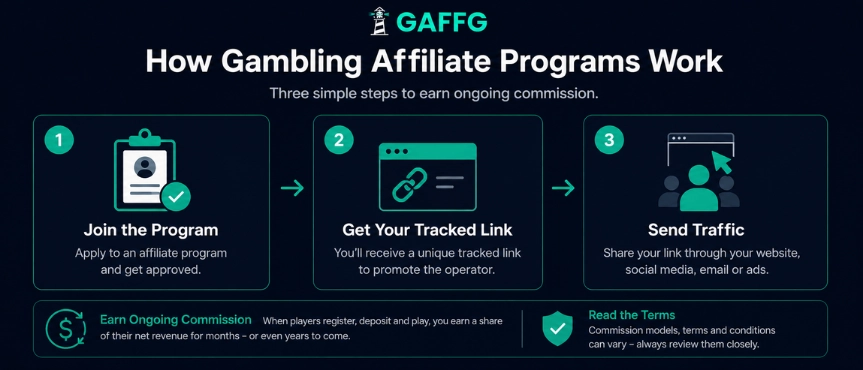
Where most verticals deal with single, completed sales, iGaming affiliation is an ongoing revenue share relationship. That one player can generate income for months, if not years to come. This is precisely why the terms governing that income should be read closely.
Tracking, Cookies, and Attribution
Operators track your referrals using tracking links, browser cookies, and the player ID created when registering. Cookie duration decides how long that credit remains with you. With a 30-day cookie, a player visiting your site and registering three weeks later is still attributed to you. With session-only cookies, that delayed registration is completely lost.
Attribution is how credit is applied when multiple sources refer to the same player. Last-click attribution awards the sale to whoever sent the player last; first-click rewards the original source of the player. Lifetime deals credit the affiliate for every penny that player spends. Lifetime tracking is how most large earners drive their commissions. Tracking can vary in quality from program to program. Broken tracking links or short cookies cost affiliates money. For this reason, it's important to test your links prior to investing in traffic.
Commission Models Explained
Your payout method is defined by the commission model. Choosing an inappropriate commission model for your traffic means leaving money on the table. The most common payment models are revenue share, CPA deals, and hybrid. So, there is no single best option; it depends on your traffic volume, player quality, and how patient you are with payback.
Revenue Share
Revenue share deals pay you a perpetual percentage of the net revenue generated by the operator from your referred players, often for their entire lifetime. The benefit is that you get compounding residual income that pays you for high-value players over and over again. The downside is you'll need to wait for it to build: it accrues slowly and fluctuates with the operator's margins.
Rates are often tiered, with higher percentages (typically ranging from 25% to 45%) becoming available as you refer more players. So, revenue share is ideal for affiliates with stable, loyal traffic who prefer to let passive income build over time rather than need a payout this month.
|
Pros |
Cons |
|
Recurring income that compounds as your referred players keep playing |
Slow to build, early months can be lean while the player base accumulates |
|
Rewards high-value, long-term players — a few big spenders can pay off for months |
Earnings swing with operator margins and player activity, so income is less predictable |
|
Higher tiers unlock better rates as your volume grows |
Exposed to terms like negative carryover, where a big-winning player can wipe out a month |
CPA (Cost Per Acquisition)
With CPA you are paid a set amount per player referred that completes a qualifying action (usually a first deposit or minimum wager). The benefit is that your payout is instant and guaranteed. You know exactly how much you will earn per player. The downside is you don't get to share in the lifetime value of a high roller and qualifying requirements can be stringent.
Note that the operator will typically have strict qualifying requirements to prevent paying out on players that make a deposit then disappear. Read the qualifying requirements before you consider that payout as earned revenue.
|
Pros |
Cons |
|
Fixed, predictable payout you can forecast per player |
You forfeit any share of a big spender's long-term value — one whale earns you the same as a casual player |
|
Cash arrives fast — you're paid once the qualifying action is met, not months later |
Qualifying criteria can be strict, so not every signup converts into a payout |
|
Simpler to scale with high-volume traffic; no waiting on player lifetime value |
Only pays once; no recurring income from players who stick around |
Hybrid Deals
This is a small CPA payment up front with revenue share on top. Hybrid deals are common since they allow you to put some money up front for expenses but still enjoy most of the long-term upside potential. Hybrid deals are normally negotiated, rather than advertised, so this is where talking to your affiliate manager can be very beneficial.
|
Pros |
Cons |
|
Best of both models — upfront cash flow plus recurring long-term income |
Usually must be negotiated, so it's harder to access than standard deals |
|
The CPA portion helps cover acquisition costs while revenue share builds |
Each side is smaller — a reduced CPA and a lower revshare rate than you'd get going all-in on one |
|
Balances risk: you're not fully exposed to slow revshare payback or capped CPA |
More complex to track and forecast across two payout mechanics |
The Fine Print: Payment Terms Affecting Your Earnings
Two separate programs can claim the same headline revenue share figure and pay vastly different amounts when the fine print is applied. The terms below show how earnings can silently evaporate. Knowing them is the single biggest factor between veterans and beginners.
Negative Carryover
If your referred players win big in a given month, the operator can post a negative balance for that period. With negative carryover, that loss is carried into the following month, or several months, so you earn nothing until the deficit clears. This hits pure revenue-share affiliates hardest, since one lucky player can wipe out a month of otherwise solid activity.
In fairness, some argue carryover reflects the operator's real revenue over time. Still, look for programs that state "no negative carryover" or apply a monthly reset, and treat this as a top question to ask before you sign anything.
Bundling, Fees, and Minimum Payouts
Three separate terms quietly reduce your effective rate:
- Bundling: The operator groups several brands into one revenue pool, so profits and losses offset each other. Whether that helps or hurts depends entirely on the mix of brands in the pool.
- Admin and processing fees: Some programs deduct fees before calculating commission, which pulls the real rate below the advertised one. A 30% deal with a 10% admin fee behaves closer to 27%.
- Minimum payout thresholds: The balance you must reach before withdrawing, plus how often payments run and via which methods (bank transfer, e-wallet, or crypto). A high threshold paired with monthly-only payments can leave earnings locked up for weeks.
Add all three together. Your real commission rate is the advertised rate minus bundling exposure, minus fees, adjusted for how quickly you can actually reach the payout.
Types of Gambling Affiliate Programs
“Gambling affiliate programs” is an umbrella covering several verticals, each with its own audience, commission plans, and content approach. The right gambling vertical depends on the traffic you already have and where your niche expertise lies.
Casino Affiliate Programs
Casino affiliate programs are the largest and most competitive vertical, built around slots and table games. Lifetime-value potential on the revshare model is strong, and volume is high, though player churn is too. It's the default entry point for most new affiliates and also the most crowded.
Sportsbook Affiliate Programs
Sportsbook affiliate programs centre on betting, with traffic that spikes seasonally around major events and a strong CPA culture. Players can be loyal for years, but sportsbook margins run thinner than casino ones. Sports content also demands constant freshness: odds, fixtures, and tips all age quickly.
Poker & Bingo Affiliate Programs
Poker and bingo affiliate programs serve two smaller, community-driven audiences. Poker is skill-based, loyal, and higher-value but harder to acquire. Bingo is social and often lower-deposit, yet sticky and community-led, skewing to a distinct demographic. Both reward affiliates who genuinely understand the community they write for.
Lottery Affiliate Programs
Lottery affiliate programs are a lower-friction, broad-appeal vertical: a simple product, wide audience, and easy conversion, usually at a lower per-player value. It works well as a top-of-funnel offer that complements a sportsbook or online casino site.
Game Provider Affiliate Programs
Game provider affiliate programs are B2B-leaning partnerships tied to the studios that build the games rather than the casino brands that host them. They matter to affiliates and iGaming industry readers focused on the supply side, and they differ from player-acquisition programs because the "conversion" is often a licensing lead or content deal, not a depositing player.
How to Choose the Right Program for Your Traffic
Forget the idea of one "best" gambling affiliate program. The right program is the one that matches your traffic, is run by a trustworthy operator, and carries terms you have actually read. The three checks below turn that into a simple framework.
Match the Program to Your Traffic
Look at what your traffic is like – big-volume, less-targeted ones tend to work better with CPAs, where you earn a fixed amount per install. Consistent, high-intent, repeat visitors may do better with revenue share where lifetime value will multiply. If you have a balanced mix of both, consider a hybrid model.
Take geography into account as well, because many programs offer more for players in certain regions, as well as device mix and what vertical your audience truly belong in. Consider your quality and volume before just going after the highest rate. 40% revenue share on low-value players will not equal out to as much as a modest CPA on the correct players.
Check Licensing and Reputation
Will you be paid? That’s entirely up to the operator behind the program. Operators who aren’t licensed or are just poorly run can result in slow payments, commissions mysteriously reduced without telling you, or players that don’t ever convert because they don’t trust the brand. See which jurisdictions it is licensed by. Whether that be the MGA, Curaçao, the UKGC or any other regulator, double-check the licence is legitimate.
Research how long the program has been around and look for authentic affiliate feedback on if they’re paid timely and in full. We do unbiased reviews and have direct contact with affiliate managers ourselves. It’s a shortcut to doing your due diligence if you don’t have time to do it yourself.
Read the Full Terms Before Committing
Run this quick checklist before you sign up anywhere:
- Negative carryover policy: reset monthly or carried forward?
- Payout threshold, schedule, and available payment methods.
- Cookie duration and attribution rules (last-click, first-click, or lifetime).
- Any bundling arrangements or admin fees deducted before commission.
- Whether the operator can change terms unilaterally, and with what notice.
If they make any of these things difficult to find or hesitate to answer outright, consider that a response.
Red Flags to Watch For
Most bad deals announce themselves early. Watch for these warning signs, each of which maps directly to your wallet:
- Unclear or concealed terms: if you can't locate the carryover or fee requirements, you can't know how much you will earn.
- No transparent licensing: unregulated operators have no external body forcing them to pay you.
- Suspiciously high rates with no specifics: a banner claiming "60%" with no tier structure or fees listed is usually a scam.
- No reset on negative carryover: one winning player can zero out your income for months.
- High payout thresholds with slow schedules: your money is tied up while continually throwing traffic at them.
- Non-responsive or incapable support: if they don't answer your questions now, they won't do when your payment is overdue, either.
- Changing terms retroactively: if they've slashed bonuses/payments for existing affiliates in the past, it can happen again.
- Not reliable tracking: if you can’t confirm that clicks and signups are being tracked, you have no choice but to trust they’re paying you correctly.
Not all red flags are dealbreakers, though. Bundling can work for certain types of traffic; if payments are consistent, then a higher threshold is acceptable. However, each one is something that should be answered prior to driving traffic, not afterwards.
Your Next Step in Gambling Affiliate Marketing
Gambling affiliate programs can offer a legitimate, strong, long-term revenue stream. They have the potential to pay out on the same players for years to come. Success really comes down to choosing the right commission structure and understanding the terms better than someone going after the highest advertised rate. The highest-paying gambling affiliate program isn't always the best. The best program is the one that suits your casino traffic and pays you fairly and promptly.
Once you’ve found a program you like, take it one step further. Evaluate your options from the directory above against the payout model and terms checklist and let our objective reviews along with the online gambling industry experience answer any questions you may have before you commit your first click.